
Stylist Guide › Section 3: Lighting › Rule #79
Stand at the kitchen bench in an open-plan apartment and look across the room. Industrial black pendants over the island. A brass globe lamp on the dining sideboard. A white ceramic lamp by the sofa. A rattan floor lamp in the corner. Four lights, four stories, one room.
The rule in one minute. In an open-plan space, every light is seen together, so lamp and pendant styles should belong to one family. Pick one material or finish (black metal, brass, white ceramic, natural rattan or linen) and repeat it across the kitchen, dining and living zones, with matching shade colours and globe colours. Two finishes at most. Matching styles make one big room read as a planned whole; mixed styles make it look furnished in stages.
Why open plan changes the rule
One room: one view.
Four zones: still one view.
In separate rooms, each lamp has its own space. A brass lamp in the bedroom and a ceramic one in the study never meet. Doors keep them apart.
In open plan, there are no doors. From the bench, the dining pendant, the sofa lamp and the corner floor lamp all sit in one sightline, and in one photo.
Mixed styles fight. Black metal says industrial. Rattan says coastal. Brass says glam. White ceramic says Scandi. Together, they say "bought one at a time".
The same open plan, two ways
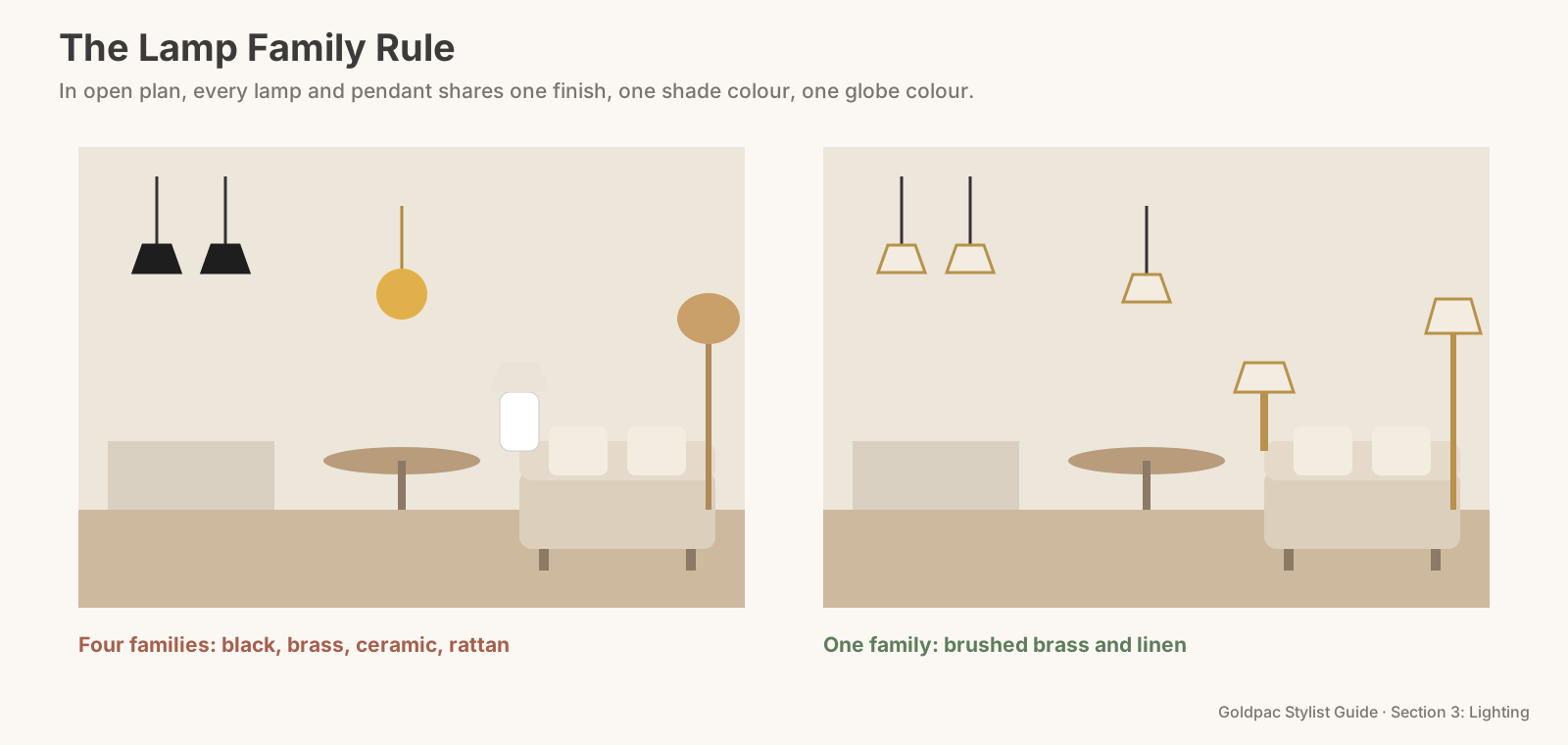
Way one: four families. Black cage pendants over the island. Brass globe on the sideboard. White ceramic lamp by the sofa. Rattan floor lamp in the corner. Each one is perfectly fine on its own, in its own corner. Together, they're noisy.
Way two: one family. Brushed brass pendants with linen shades over the island. A brass-based lamp with a linen shade on the sideboard. A slim brass floor lamp with a linen shade by the sofa. Same metal, same shade, three heights.
| Four families | One family | |
|---|---|---|
| Finishes in view | 4 | 1, plus linen |
| Shade colours | mixed | matching |
| Reads as | collected over time | designed together |
| Eye movement | jumps between fittings | follows the zones |
| In photos | busy | calm, joined up |
Verdict: way two. The lights become a thread that ties kitchen, dining and living together (Rule #66 covers zoning with light).
Should lamps match in an open-plan space?
They should belong to one family: the same finish, similar shapes and matching shade colours, though they don't need to be identical. One metal or material, one shade colour, one globe colour. A second finish can work if it repeats at least twice. Pendants, table lamps and floor lamps can differ in shape as long as the family is clear.
The Lamp Family Rule
- Stand where you see the whole open plan. List every pendant, lamp and floor lamp in view.
- Find the fixed one. Usually the kitchen pendants. Its finish leads.
- Match the movable lamps to it. Same metal or material, or a neutral partner (white, linen, timber).
- Match the shades. One colour: white, cream or linen.
- Match the globes. One warm colour (Rule #63).
- Move the odd ones out to bedrooms or a study, where doors keep them apart.
The Lamp Family Rule: in open plan, every lamp and pendant shares one finish, one shade colour and one globe colour, with two finishes at most.
"Isn't a mix more interesting?"
Variety works in shape, not in finish. A tall floor lamp, a round table lamp and a pair of cone pendants can look interesting together because they share one metal and one shade colour. Change the shapes, keep the family. Four finishes isn't variety; it's four separate decisions.
Pack-away list
Goes to another room: the odd-finish lamp, coloured or patterned shades, novelty lamps, a lamp whose shade has yellowed.
Stays in the open plan: lamps in the leading finish, matching shades, one floor lamp, one or two table lamps.
The blind spot: each lamp was a good buy
Every lamp made sense when you bought it. It suited the corner, it was on sale, it was a gift. You remember each one separately.
A buyer sees them all at once, from the bench. Stand there, take a photo, and count the finishes.
What if…
The kitchen pendants don't suit anything you own. Let them lead anyway. Choose white or linen lamps, which sit with almost any pendant.
It's a small studio. Even more reason to match. One finish across two or three lights makes a studio feel calm.
FAQ
Can you mix metal finishes in lighting? Yes, two at most, and each should appear at least twice. Black and brass is a common pair. Four finishes in one open space looks unplanned.
Do pendant lights have to match other light fixtures? They don't need to be identical, but they should share a finish or material with the lamps in the same open space.
Lamps are the easiest pieces to swap between rooms, and the easiest to forget to. With Photo Ready Styling, our stylist styles your home with your own furniture and lamps before the photos, moving each one to where it belongs. For empty homes, our home staging brings our own pieces: send us the address and a fixed styling quote lands within two hours. See current prices.
Keep reading: Rule #66: Use lighting to zone open-plan spaces (zoning open-plan spaces with light) · Rule #53: Match door hardware to the furniture finishes (matching door hardware to furniture) · Rule #83: Don't mix too many light fitting styles in one room (limiting light fitting styles in one room)
◀ Previous: Rule #78: Avoid harsh spotlights over furniture · Section 3 contents · Next: Rule #80: Replace every globe before the photos and open homes ▶
Part of the Goldpac Stylist Guide: 220+ home staging rules from Goldpac's Sydney styling team.