
Stylist Guide › Section 3: Lighting › Rule #80
"How many globes are in this house?"
"I don't know. Twenty?"
"Count the downlights in the kitchen."
"…Oh."
The rule in one minute. Before photos and the first open home, walk every room, inside and out, and replace every globe that is dead, dim, flickering, mismatched in colour or old enough to look yellow. Use one warm white (2700 to 3000K) in living areas and match every globe within each fitting. A typical three-bedroom home has dozens of globes; one dead one in a pendant or a dim one in a lamp shows up in photos far more than its size suggests.
Why every globe matters
- Dead globes look like neglect. A pendant with one globe out, a dark downlight in a row of six: buyers see a job left undone and wonder what else was left.
- Mismatched globes look patchy. A cool globe in a warm room shows as a blue patch in photos (Rule #298 covers matching light colour).
- Old globes dim. Older globes, especially compact fluorescents, lose brightness and can turn yellow or green over time.
- Flicker spoils video. Walk-through videos and some photos show flicker the eye barely notices (Rule #87 covers flickering globes).
"It's only one globe, nobody will notice." Buyers usually won't notice one globe. They notice a ceiling with a gap in it, a pendant that looks broken and a room that's dimmer on one side. Each takes a minute to fix and a whole campaign to undo.
Should you replace light bulbs before selling?
Yes: every dead, dim, flickering or mismatched globe in the home, before photos and the first open home. It's one of the cheapest, fastest jobs on any pre-sale list, and it affects every photo taken inside.
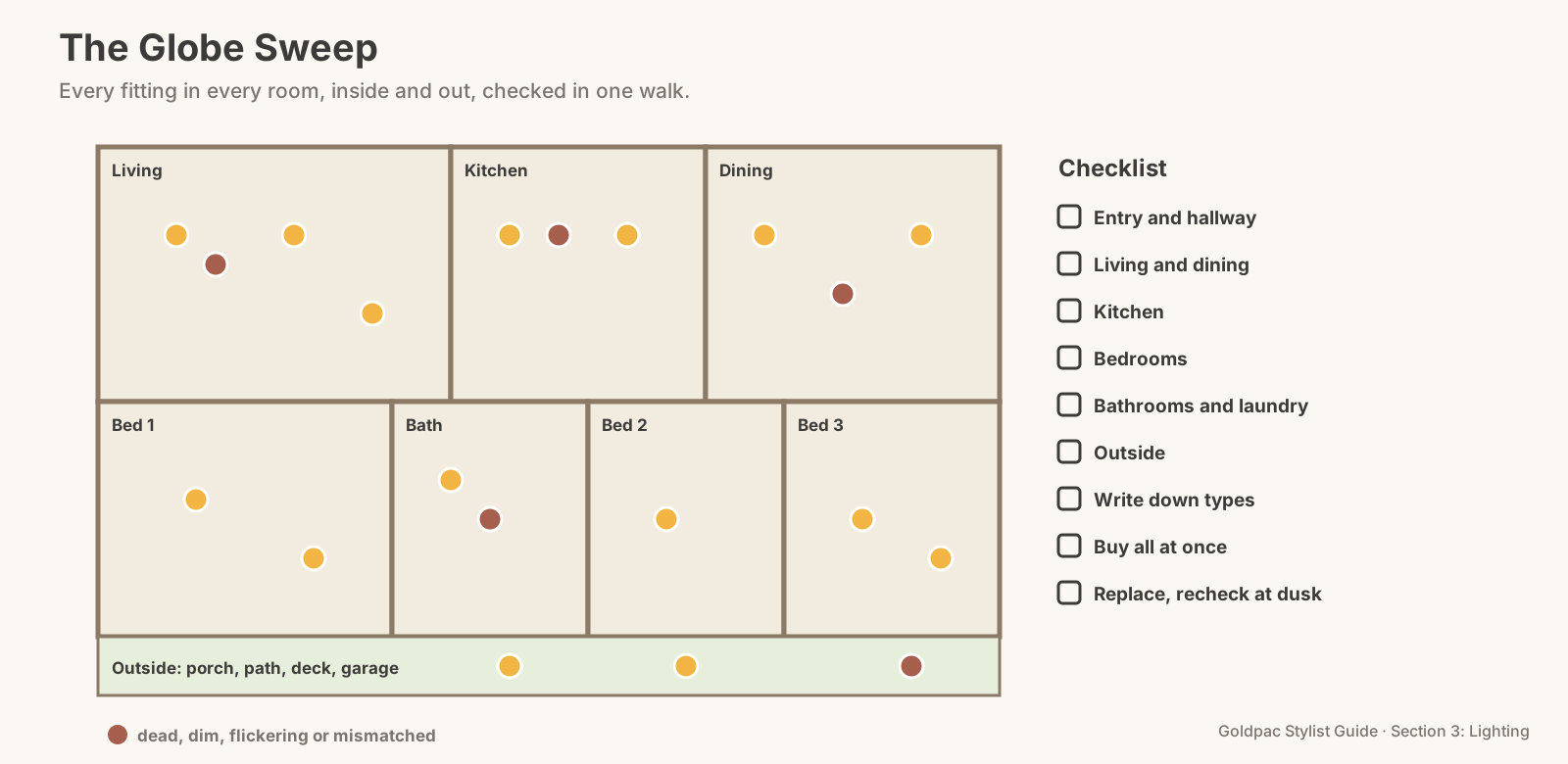
The Globe Sweep
Walk every room in this order. Turn each light on as you go.
- Entry and hallway. Ceiling lights, wall lights, the porch light.
- Living and dining. Downlights, pendants, every lamp, any floor lamp.
- Kitchen. Downlights, island pendants, under-cabinet lights, the rangehood light.
- Bedrooms. Ceiling lights, bedside lamps, wardrobe lights.
- Bathrooms and laundry. Vanity lights, heat lamps, exhaust fan lights.
- Outside. Front porch, side path, deck, garden lights, garage.
- Write down every fitting that has a dead, dim, flickering or mismatched globe, with the globe type (bayonet, screw, GU10 downlight or other).
- Buy all replacements at once, from one brand and range, in one warm white.
- Replace, then walk again at dusk.
The Globe Sweep: every fitting in every room, inside and out, checked in one walk, with all replacements bought at once in one warm white.
Globe types you'll meet
- Bayonet (B22): push in and twist. Common in older ceiling fittings and lamps.
- Edison screw (E27, or the smaller E14): screws in. Common in lamps and pendants.
- GU10: two short pins with a twist. Many downlights and spotlights use these.
- Integrated LED: no separate globe at all; the whole fitting is the light.
Take a photo of each globe type, or the old globe itself, to the shop. It saves a second trip.
Keep a spare kit
Buy two or three extra of each type you use. During a four-to-six-week campaign, something will blow before an open home. A labelled box of spares in the laundry means it's a two-minute fix, not a missing light in the photos.
Time and effort
- The walk-through: about 20 to 30 minutes for a three-bedroom home.
- Buying globes: one trip, if you've written down the types.
- Replacing them: a few minutes per fitting. Downlights with clips take longer.
- Integrated LED downlights: can't be swapped like globes; a licensed electrician replaces the whole fitting.
The phone-camera test
At dusk, with every light on, photograph each room from the doorway. Look at the ceiling in each photo. A dark downlight, a slightly bluer one or a dimmer pendant is easy to spot on a screen, and much easier than looking up at the real ceiling.
The blind spot: you stopped seeing the dead ones
A dead globe is noticed for a day. Then the room adjusts. You use the other light, you turn on the lamp, and the empty socket in the pendant becomes normal.
A buyer sees it the first time they look up. A photographer sees it in every frame where that ceiling shows.
What if…
You can't reach a high ceiling fitting. Use a proper step ladder, or ask someone else to help. If it's very high or awkward, a handyman or electrician can do several in one visit.
The fitting itself is broken. Replacing the globe won't fix it. For hardwired fittings, use a licensed electrician.
You're renting. Replacing globes is usually a tenant's job; check your lease.
FAQ
What colour globes should I buy before selling? Warm white, 2700 to 3000K, for every living area, matched within each room. Buy them all from one brand and range so they look the same.
Globes are the smallest job with the widest effect. With Photo Ready Styling, our stylist styles your home with your own furniture before the photos and checks that the lighting works with it. If you'd rather do it yourself, a Photo Ready Consultation lists every fitting that needs attention, room by room, within 48 hours of the visit. See current prices.
Keep reading: Rule #298: Same light colour in every globe (matching the colour of every globe) · Rule #63: Use warm white globes (2700–3000K) in living areas (warm white globes for living areas)
◀ Previous: Rule #79: Use matching lamp styles across open-plan zones · Section 3 contents · Next: Rule #81: Use warm light to make hallways inviting ▶
Part of the Goldpac Stylist Guide: 300+ home staging rules from Goldpac's Sydney styling team.