
Stylist Guide › Section 3: Lighting › Rule #72
The light that makes a kitchen look good in a listing photo isn't the one in the ceiling. It's the one under the cupboards.
The rule in one minute. Task lighting is light aimed exactly where work happens: the kitchen bench, the stove, the desk. Without it, overhead downlights sit behind you and throw your own shadow onto the bench. Add under-cabinet lights along kitchen benches, pendants over an island, and a desk lamp on the opposite side to your writing hand in a home office. Use warm or neutral white, diffused, and switch it all on for photos.
Why task lighting sells kitchens and offices
- It removes shadows where buyers look. A bench lit from above and behind has a dark band along the back, right where the splashback meets the benchtop.
- It makes surfaces glow. Light washing along a clean benchtop is one of the most photogenic sights in a kitchen.
- It shows the room works. A desk with a lamp says "home office". A desk without one says "spare table".
- It shows care. Under-cabinet light reads as a considered, well-finished kitchen.
Two ways to light the same kitchen
Picture a galley kitchen with a row of downlights down the middle of the ceiling and wall cabinets above the bench.
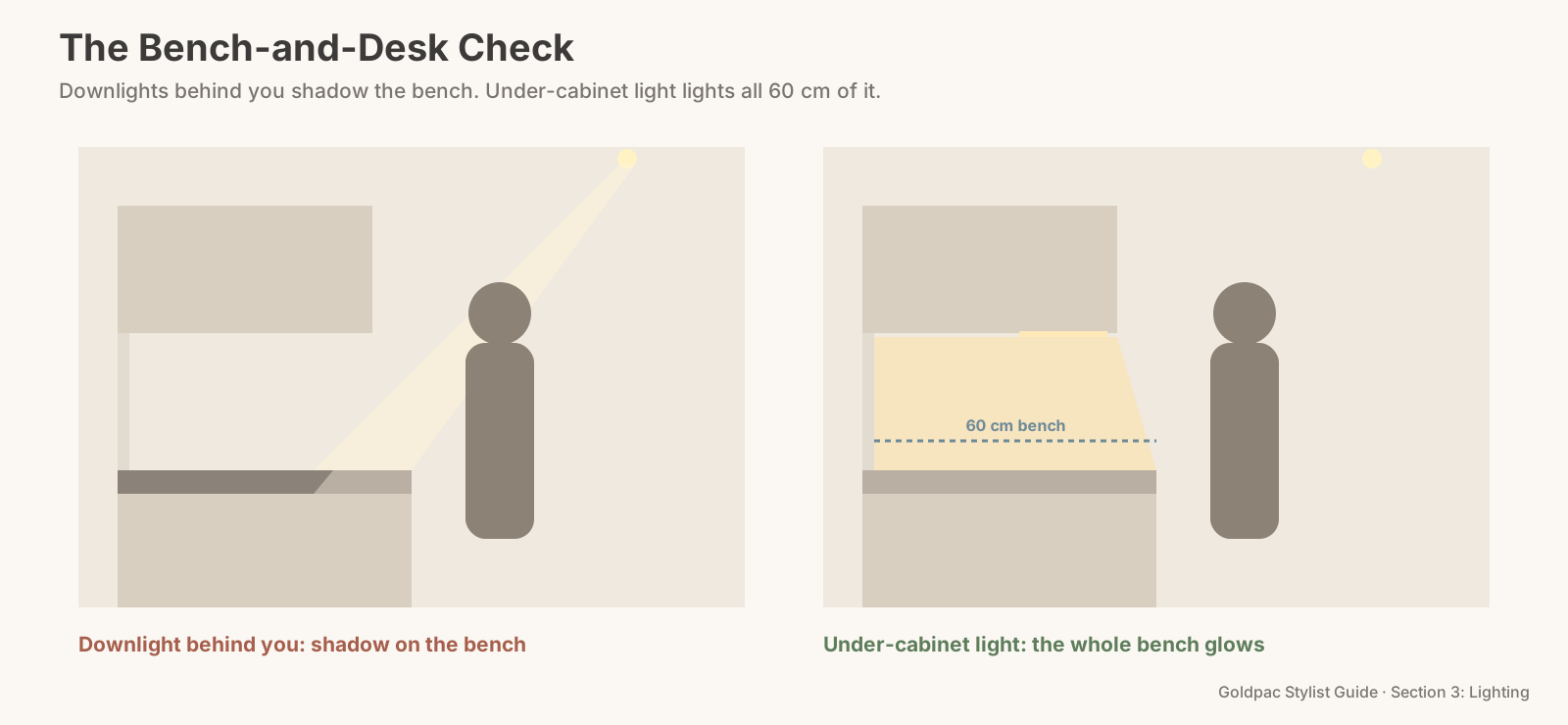
Way one: downlights only. The light comes from behind whoever stands at the bench. Their head and shoulders block it. The back of the bench, under the wall cabinets, sits in shadow. In photos, the splashback looks dull and the bench looks narrower.
Way two: downlights plus under-cabinet light. A strip or puck lights under each wall cabinet light the bench from the front. The whole benchtop glows from the splashback forward. In photos, the kitchen looks brighter, deeper and more expensive.
| Downlights only | Plus under-cabinet light | |
|---|---|---|
| Light direction | from above and behind | from the front, at bench level |
| Back of bench | in shadow | evenly lit |
| Splashback | dull | glowing |
| Your shadow | across the bench | none |
| In photos | flat, narrower | bright, deeper |
Verdict: way two. If your kitchen has wall cabinets, under-cabinet light is the single most useful lighting upgrade for a sale.
What is the best task lighting for a kitchen?
Under-cabinet lights along the bench, plus pendants over any island. Under-cabinet lights should be warm or neutral white, diffused so you can't see individual points, and mounted toward the front edge of the cabinet so they light the whole bench depth (Rule #69 covers warm strips). Over an island, pendants light the work surface and mark the zone.
The numbers
- About 60 cm: a typical bench depth in Australian kitchens. Under-cabinet light needs to reach all of it.
- Front third of the cabinet underside: where under-cabinet lights work best, so light falls across the bench, not just down the splashback.
- 75–90 cm: a common guide for the gap between the bottom of island pendants and the benchtop.
- One pendant per 60 to 80 cm of island length, roughly, for an even spread.
- Opposite your writing hand: where a desk lamp goes, so your hand doesn't shadow the page. Right-handed, lamp on the left.
- To the side of the screen: never directly behind or in front of a monitor, to avoid glare.
The Bench-and-Desk Check
- Stand at the kitchen bench with only the ceiling lights on. Is your shadow on the bench?
- Check under the cabinets. Any existing lights? Are they working and warm?
- Add plug-in or battery under-cabinet lights if there are none. They stick on in minutes.
- Check the island pendants. Height, globe colour, all globes working.
- Go to the desk. Add a lamp on the side opposite your writing hand, angled away from the screen.
- Switch everything on for photos and inspections.
The Bench-and-Desk Check: under-cabinet light across the full 60-centimetre bench, pendants 75 to 90 cm above any island, and a desk lamp on the side opposite your writing hand.
The home office in detail
Buyers now look for a place to work. A study, a nook, a desk in a bedroom: each one needs to read as a working space in photos, and light is what does it.
- Desk lamp on, always. Even in daylight, a lit desk lamp makes the desk look used and ready.
- Window to the side. The best desk position has daylight coming from the side, not behind the screen and not behind the chair.
- Screen off or showing something calm. A dark screen with a lit lamp looks cleaner than a bright screen full of windows.
- One cable, hidden. The lamp cord runs down the back leg of the desk, out of sight.
Laundries and bathrooms
These are task spaces too. A laundry with a single ceiling batten looks like a utility cupboard. A small strip under an overhead cupboard or a wall light beside the tub makes it look finished. In bathrooms, the task is the mirror, and side lighting beats a single ceiling light (Rule #90 covers this in full).
On photo day
Turn every task light on before the photographer arrives. Under-cabinet lights, island pendants, the rangehood light, the desk lamp. Check each one works, and that every globe in each fitting matches. Clear the bench to three items at most so the light has something clean to fall on, and wipe the splashback, because task light shows every smear on glass and stone.
The blind spot: you work in your own shadow
You've cooked in that shadow for years. You lean slightly, move the chopping board forward, and never think about it. The darkness at the back of the bench just became where the kettle and the knife block live.
Buyers see the bench empty and lit by the photographer's preferred light. If the back half is dim, the kitchen looks smaller than yours feels to you.
What if…
There are no wall cabinets (common in open-plan kitchens with open shelving). Use pendants over the bench, or wall lights mounted above it, instead of under-cabinet light.
You're renting. Battery or rechargeable stick-on lights work without wiring and come off cleanly.
There's no study, just a desk in a bedroom. A desk lamp still turns it into a work zone. Keep the desk clear except for the lamp and one notebook.
FAQ
Is under-cabinet lighting worth it before selling? Often, yes. It's a small job, especially with plug-in or battery lights, and it makes the bench look brighter and deeper in listing photos.
What colour should kitchen task lighting be? Warm or neutral white, matched to the other kitchen lights. Very cool light can make food and timber look flat.
Where should a desk lamp go? On the side opposite your writing hand, angled so it doesn't reflect in the screen.
Kitchens and studies are where buyers picture daily life, and light shows them it works. With Photo Ready Styling, our stylist styles your home with your own furniture and lamps before the photos, including the bench and desk. If you'd rather do it yourself, a Photo Ready Consultation lists every light to add or switch, room by room, within 48 hours of the visit. See current prices.
Keep reading: Rule #69: Avoid cold LED strips, except for a soft ambient glow (warm versus cool LED strips) · Rule #45: Choose kitchen colours that make food look good (kitchen colours that make food look good) · Rule #74: Use hidden lighting under shelves and cabinets (hidden lighting under shelves)
◀ Previous: Rule #71: Place lights at different heights · Section 3 contents · Next: Rule #73: Dining lights should never block the view across the table ▶
Part of the Goldpac Stylist Guide: 220+ home staging rules from Goldpac's Sydney styling team.