
Stylist Guide › Section 3: Lighting › Rule #74
"Do we need lights under the shelves?"
"Do the shelves have anything worth seeing?"
"Some books. A vase."
"Then light them. Quietly."
The rule in one minute. Hidden lighting under shelves, floating cabinets and vanities adds a soft wash of light that makes a room feel finished and deep. Keep the light source out of sight: mounted toward the front of the underside, behind a lip or in a diffuser channel, so you see the glow and not the globe or the dots. Use warm white, keep the shelves styled sparely, and switch it on for every photo and inspection.
Your questions, our answers
Hidden lighting is now common in new builds and renovations, and it raises the same few questions. These are our answers.
"What does hidden lighting actually do?"
It lights surfaces from an unexpected place. Light coming from under a shelf washes down the wall and across whatever sits below. The eye sees a glow with no visible source. That reads as quality and calm.
It adds a layer. Ceiling lights, lamps and now a low, soft wash. The room gains depth without another object in it.
It makes shelves look styled. A lit shelf with three objects looks curated. An unlit one with the same three objects looks like storage.
"Where does it work best?"
- Open shelving in living rooms and kitchens.
- Floating TV units and sideboards, with a glow along the floor beneath.
- Floating vanities in bathrooms, with light washing the floor.
- Bedhead shelves or ledges, for a soft background glow.
- Glass-fronted cabinets, lit from inside top or under shelves.
Under kitchen wall cabinets, the same light does a working job as well (Rule #72 covers task lighting).
Is hidden shelf lighting worth adding before selling?
Where you already have open shelves or floating units, yes; stick-on battery or plug-in strips take an afternoon. Don't build new shelving just to light it. The aim is to make existing features look finished, not to add a project.
"How do I hide the light?"
Front edge, not back. Mount the strip or puck toward the front of the shelf's underside, so the light falls on the shelf below and the wall, and the strip faces away from the eye.
Use a lip or channel. A small timber or aluminium lip on the front edge, or a frosted diffuser channel, hides the strip completely.
Warm white only. Around 2700 to 3000K, matched to the room's lamps (Rule #63). Cool light under a shelf looks like a fridge.
Where not to add it
Shelves you can't style well. A lit shelf of mismatched paperbacks and ornaments looks worse than an unlit one. Rooms with no other warm light. Hidden lighting is a layer, not the main source; add lamps first (Rule #61). Wet areas without the right fittings. In bathrooms, anything near water needs suitable, properly rated products and installation.
The Glow-Not-Globe Check
- List the shelves, floating units and vanities in the main rooms.
- Decide which ones are worth lighting. Only those styled well enough to show.
- Fit warm, diffused light toward the front of each underside.
- Crouch down and look up from a seated position. Can you see the strip or the dots? Add a lip or channel.
- Style the shelf below with no more than three objects per run.
- Switch them on with the rest of the lights for photos.
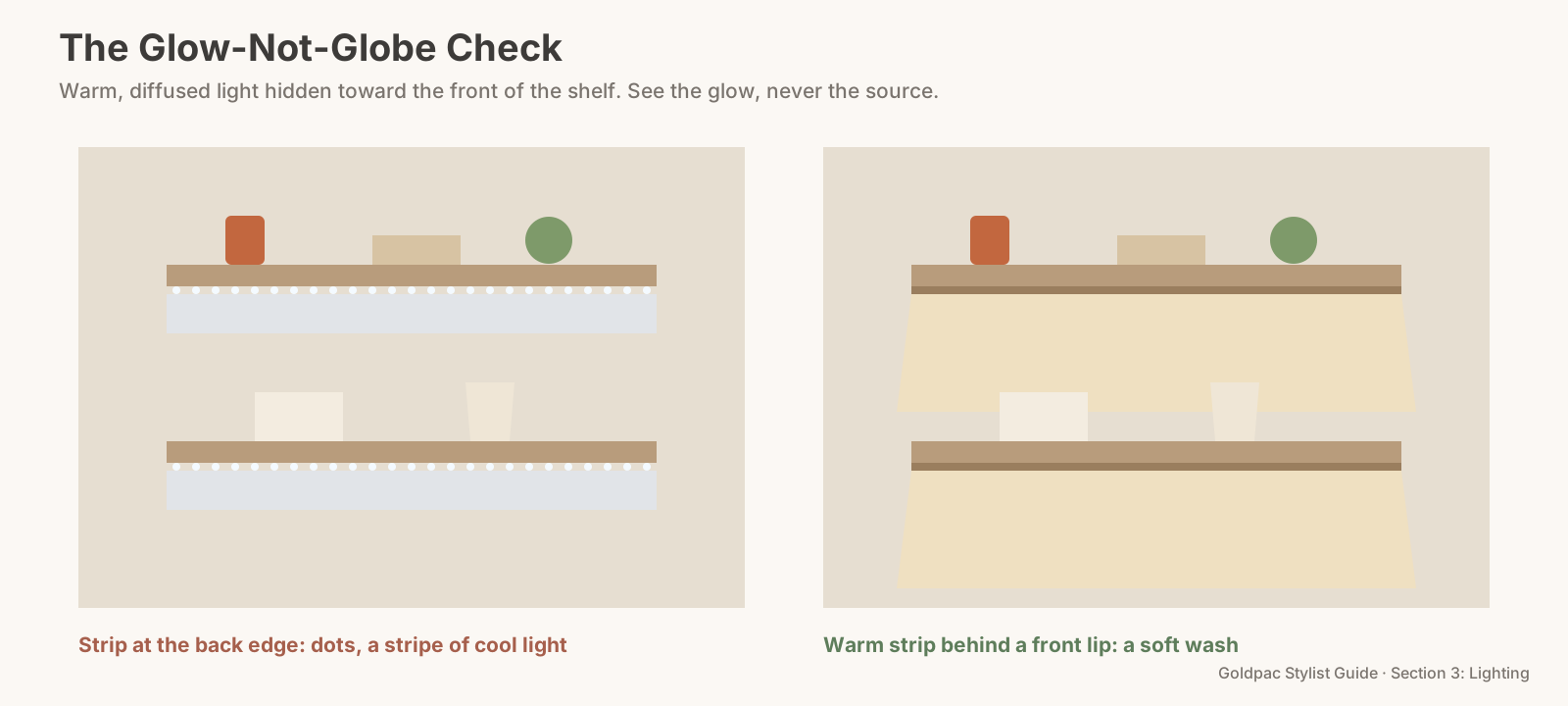
The Glow-Not-Globe Check: warm, diffused light hidden toward the front of each shelf's underside, so you see the glow on the wall and never the source.
Mistake and fix
Mistake: a strip stuck to the back edge of the shelf. Fix: it lights the wall in a stripe and shows its dots. Move it to the front third of the underside.
Mistake: lighting a shelf crowded with twenty things. Fix: light shows clutter beautifully. Edit to three objects first.
Pack-away list
Goes in the box: most of what's on the lit shelves: paperbacks, small ornaments, paperwork, chargers, mail.
Stays out: three objects per shelf run, mixed in height. A few books stacked flat, a vase, a small plant.
The blind spot: you see the shelf from standing
You look down on your shelves. Standing up, you never see the underside, the strip or its dots.
A buyer on the sofa, or a camera at chest height, sees them from below. Crouch to sofa height and look again.
What if…
You're renting. Battery or rechargeable stick-on lights come off cleanly. Keep the original state photos for your bond.
There's no power near the shelf. Rechargeable puck lights last long enough for a campaign; recharge before each open home.
FAQ
What colour should under-shelf lighting be? Warm white, around 2700 to 3000K, matched to the lamps in the room. Cool white under shelves looks harsh in photos.
Lit shelves are a small detail that makes a home look finished. With Photo Ready Styling, our stylist styles your home with your own furniture and objects before the photos, including what goes on each shelf. Prefer to do it yourself? A Photo Ready Consultation leaves a written room-by-room plan within 48 hours of the visit. See current prices.
Keep reading: Rule #72: Use task lighting in kitchens and home offices (task lighting for benches and desks) · Rule #69: Avoid cold LED strips, except for a soft ambient glow (warm versus cool LED strips) · Rule #86: Backlight shelves that hold glass objects (backlighting glass on shelves)
◀ Previous: Rule #73: Dining lights should never block the view across the table · Section 3 contents · Next: Rule #75: Avoid coloured lighting in a staged home ▶
Part of the Goldpac Stylist Guide: 300+ home staging rules from Goldpac's Sydney styling team.