
Stylist Guide › Section 2: Colour & Visual Impact › Rule #51
If grey goes with everything, why does your grey sofa look so wrong on that beige carpet?
The rule in one minute. Grey isn't one colour. Cool greys lean blue, green or violet; warm greys lean yellow or brown. Pair cool greys with blues, crisp whites and black, and warm greys with beige, cream, timber and terracotta. Mixing a cool grey with a warm beige makes both look slightly dirty. Check a grey's lean in 30 seconds by holding it next to a blue swatch and a beige one: it will sit happily with only one of them.
The myth: grey is neutral, so it matches anything
"It's grey. It's neutral. It goes."
"Which grey?"
"…The grey one."
That's the myth in one exchange. For years, grey was the default safe choice in a lot of Australian homes: grey sofas, grey carpet, grey tiles, grey walls. The idea was that grey has no colour, so it can't clash.
Why it feels right
Because some greys really are close to neutral. A grey mixed from little more than black and white has almost no lean. Next to anything, it looks quiet.
And because grey looks neutral on its own. In the shop, under bright white light, a grey sample looks like grey. You only see its undertone when you put it next to something else.
Why it backfires
Most greys aren't pure. Paints, fabrics and tiles are mixed from pigments, and most greys carry a little blue, green, violet, yellow or brown. That small lean decides what the grey gets along with.
Cool grey next to warm beige. The blue in the grey makes the beige look yellowish and stained. The yellow in the beige makes the grey look cold and slightly blue. Both look dirtier than they are.
Warm grey next to icy blue. The grey suddenly looks brownish and muddy.
And the light changes everything. A cool grey in a shaded, south-facing room can look almost blue. The same grey in a north-facing room in afternoon sun looks softer and warmer. Rule #46 covers how light should guide your base tone.
What colours go with grey?
It depends on the grey's undertone. Cool greys go with blues, navy, crisp white, black, silver and chrome, and cool greens like eucalyptus. Warm greys go with beige, cream, warm white, natural timber, terracotta, brass and olive.
| Cool grey | Warm grey | |
|---|---|---|
| Undertone | blue, green or violet | yellow or brown |
| Pairs with | navy, soft blue, crisp white, black | beige, cream, warm white, timber |
| Metals | chrome, silver, black | brass, bronze, black |
| Best light | bright, north-facing rooms | shaded rooms, south-facing rooms |
| Clashes with | warm beige, yellow-cream | icy blue, stark white |
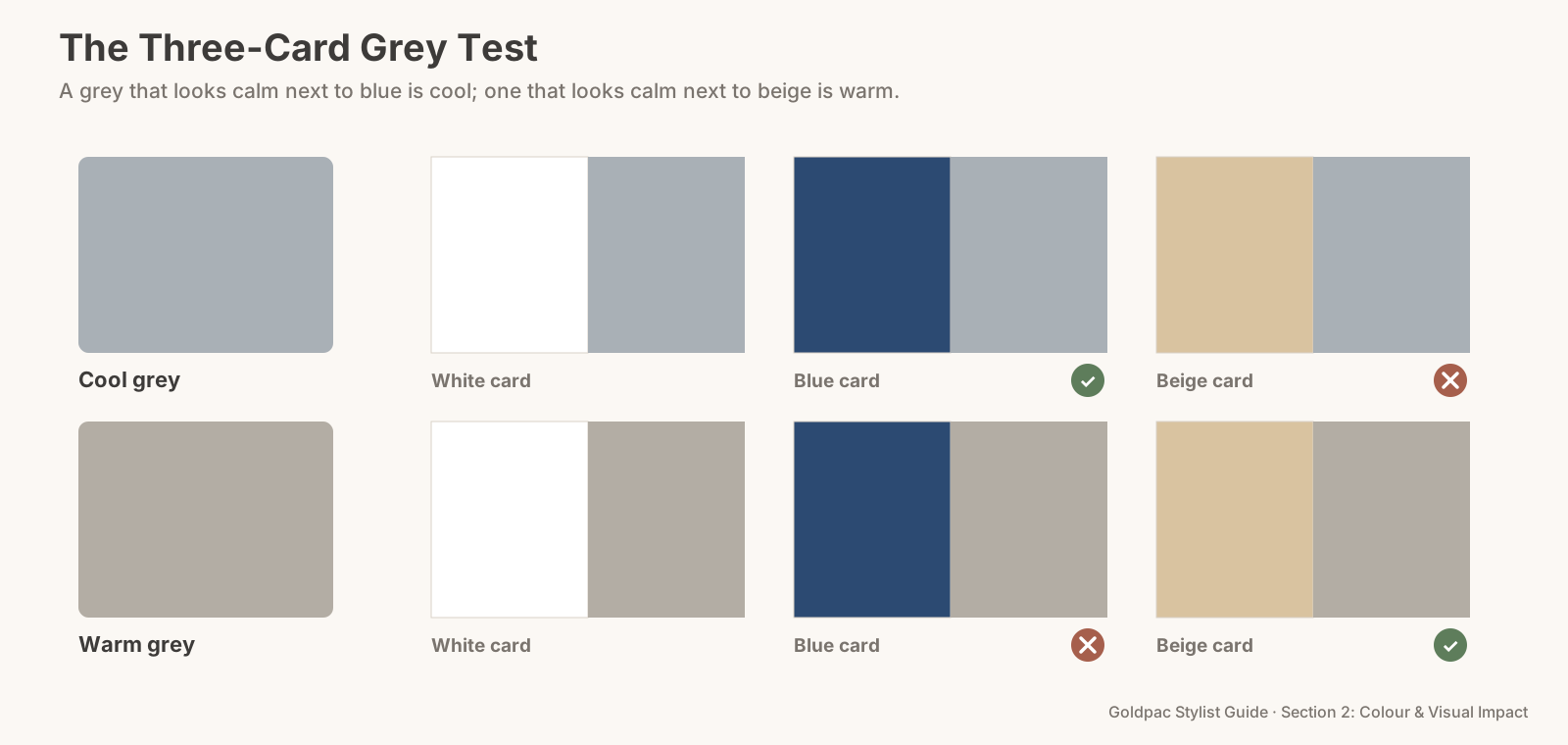
The Three-Card Grey Test
You need three things: a sheet of plain white printer paper, something clearly blue (a navy cushion, a blue book cover) and something clearly beige (a beige towel, a kraft paper bag).
- Hold the grey against the white paper. Does it look bluish, greenish, violet, or slightly yellow or brown? That's its lean (Rule #36 uses the same white-paper trick for all colours).
- Put the blue next to it. If the grey looks crisp and calm, it's cool.
- Swap to the beige. If the grey looks crisp and calm now, it's warm.
- Whichever card looks wrong is the family to keep away from that grey.
- Repeat for every big grey in the room: sofa, rug, carpet, curtains, walls, tiles.
- If the big greys disagree, the one you can't change (usually the floor or tiles) wins. Swap or cover the others to match its family.
The Three-Card Grey Test: a grey that looks calm next to blue is cool, a grey that looks calm next to beige is warm, and every grey in one room should belong to the same family.
The mini-dialogue you'll have with yourself
"The sofa's cool grey. The carpet's beige."
"Can the carpet change?"
"No."
"Then the sofa gets a warm throw, warm cushions, and the blue cushions go in a box."
That's most grey problems solved in under a minute. The fixed surface decides; the soft things follow.
The blind spot: your greys arrived years apart
Few homes buy all their greys at once. The carpet came with the house. The sofa was bought five years later. The curtains came from a different shop again. Each grey looked "grey" in its own showroom.
In your own home, your eye has adjusted to them together. A buyer walking in sees three greys from three different families in the one room, and the room looks slightly off without them knowing why.
What if…
Your floor tiles are cool grey and the rest is warm. The tiles win. Swap warm-leaning cushions and throws for white, soft blue or charcoal, and use a large cool-toned rug if needed.
Your walls are a blue-grey you can't repaint before photos. Use crisp white bedding and linen, chrome or black metals, and a navy accent. Avoid cream and yellowish timber in the same view.
The grey sofa and the beige carpet must both stay. Put a large rug in a bridging tone (an oatmeal or greige that has a little of both) between them, and cover the sofa partly with a warm throw.
FAQ
How do I know if my grey is warm or cool? Hold it against a sheet of white paper. If it looks bluish, greenish or violet, it's cool. If it looks yellowish or brownish, it's warm. Then check it next to something blue and something beige.
Can I mix warm and cool greys in one room? It's hard to do well. Most staged rooms look calmer with every grey in one family. A greige (a grey with a little beige in it) can bridge the two in a pinch.
Is grey still popular for selling a house? Soft greys still work in many modern homes, especially bright ones. In shaded rooms, warmer neutrals like greige and warm white are usually safer, because a cool grey can feel cold there.
Greys are easy to mix up when they arrive one at a time over years. A Photo Ready Consultation checks every grey in every room against your floors and light, and tells you which soft pieces to swap or cover, in a written room-by-room plan within 48 hours of the visit. For empty homes, Goldpac stages in matched palettes from our own collection: send us the address and a fixed styling quote lands within two hours, through our home staging page. See current prices.
Keep reading: Rule #36: Match the rug, curtains and accessories by undertone (the White Paper Test) · Rule #33: Cool tones open a room up; warm tones draw it in (cool walls, warm details) · Rule #55: A touch of yellow can lift a neutral scheme (a touch of yellow in a neutral room)
◀ Previous: Rule #50: Paint trims and doors the same colour for a clean look · Section 2 contents · Next: Rule #52: Avoid strong, saturated colours in small rooms ▶
Part of the Goldpac Stylist Guide: 300+ home staging rules from Goldpac's Sydney styling team.