
Stylist Guide › Section 2: Colour & Visual Impact › Rule #31
3.0 by 3.2 metres. That's a common size for a Sydney second bedroom, and it's the same floor area whether its walls are charcoal or chalk white. Buyers won't believe that, though. Light walls make that room read bigger. Dark walls make it read like a cupboard with a window.
The rule in one minute. Light walls make a room feel bigger because they reflect more light and soften the edges where walls meet, so the eye can't measure the box. For a sale, paint walls in a pale warm neutral, make the ceiling one step lighter, keep trims the same colour as the walls in small rooms, and avoid dark feature walls. The room's square metres don't change; the size buyers feel does.
The numbers that change how big a room feels
- 1 step lighter on the ceiling. A ceiling a shade lighter than the walls reads as higher.
- 0 dark feature walls. One dark wall pulls the room in by drawing the eye to its nearest edge.
- 1 colour for walls and trims in rooms under about 10 m². Fewer lines means fewer edges to measure.
- 10 to 15 cm above the window frame: where to hang the curtain rod, so the window looks taller.
- 15 to 20 cm past each side of the frame: how far the rod should extend, so the window looks wider and the curtains don't cover the glass.
- 1 large mirror opposite or beside the main window to double the light.
Do light colours make a room look bigger?
Yes: pale walls make a room read larger, because the eye uses light and edges to judge size. Light walls bounce daylight around, so corners don't fall into shadow. They also soften the line where wall meets ceiling and wall meets wall. With fewer hard edges to measure, the brain reads the room as more open. Dark walls do the opposite: they absorb light and make every corner crisp and close.
The Bigger Room Palette
- Walls: a pale, warm neutral. Warm white, soft greige or pale stone. Cool, bright whites can feel flat in Sydney's softer south light (Rule #59 covers mixing whites).
- Ceiling: one step lighter than the walls, usually a flat white. Never darker.
- Trims and doors: the wall colour in small rooms, or a matching white in larger ones, so frames don't box the room in (Rule #50).
- Floors: let them contrast gently. A mid-tone timber or a pale rug under light walls gives the room a base without shrinking it.
- Curtains: close to the wall colour, hung high and wide, so they extend the wall rather than cut it.
- One mirror, placed to catch the window.
The Bigger Room Palette: pale warm walls, a ceiling one step lighter, trims that match in small rooms, curtains hung 10 to 15 cm above the frame, and no dark feature walls.
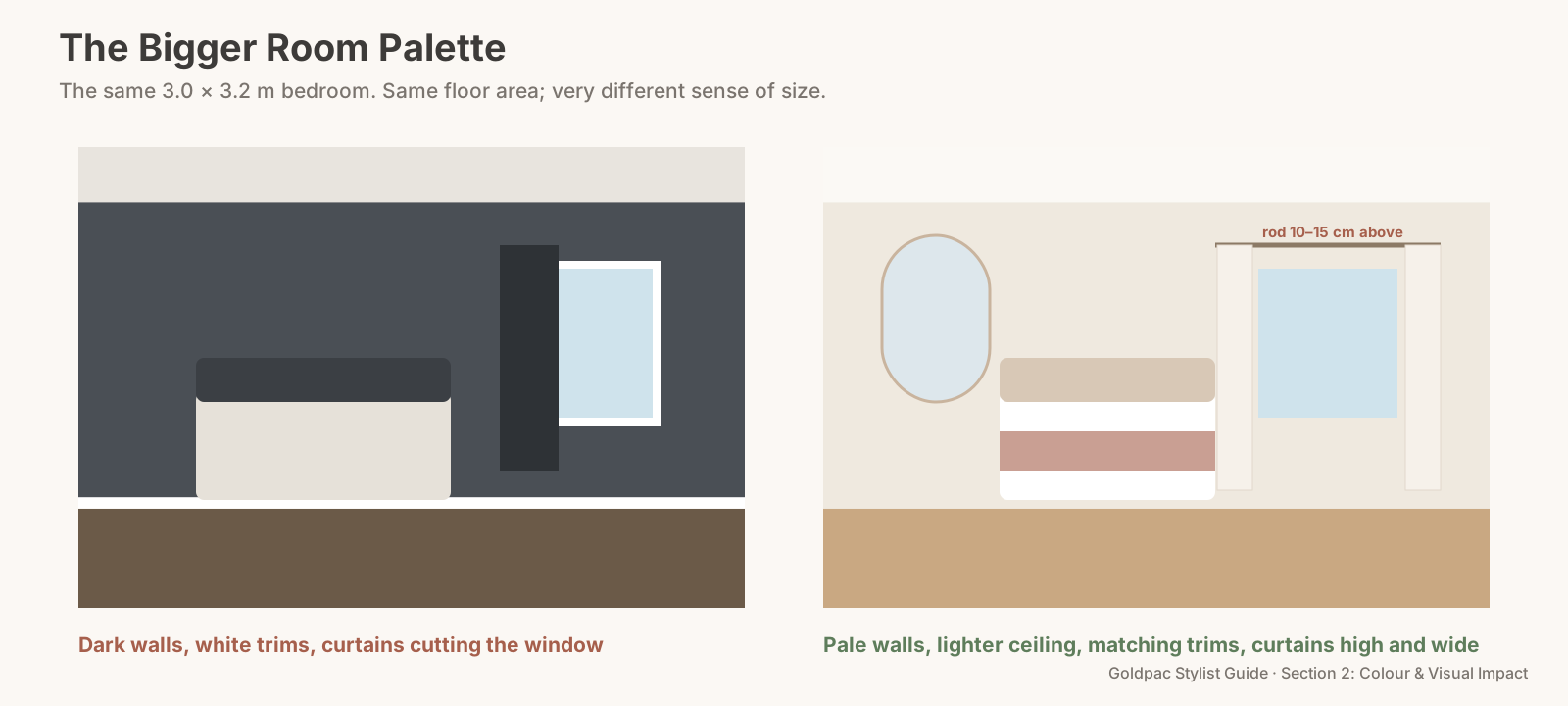
Why the edges matter more than the colour
Size is something the eye measures from corners and lines. In a room with dark walls and white trims, every door frame, skirting board and window architrave stands out as a sharp line, and each line tells the eye exactly where the room stops. Paint the trims the same as pale walls and many of those lines soften. The room's limits blur, and it feels larger.
That's the second-order insight behind this rule: it isn't only about lightness, it's about reducing contrast at the edges. A pale room with strong contrasting trims can still feel boxy. A pale room with soft edges feels open.
"We were told dark walls are fashionable now"
They are, in some magazines. In a home you're keeping, a deep colour can be beautiful and cosy. In a home you're selling, the question is different: does the room look as big as it really is in a phone-sized photo? Usually a dark room doesn't. And most buyers will want to repaint a dark room, which adds a job to their list (Rule #253).
For the value side of light colours, including the light reflectance numbers on paint charts, see Rule #255.
The blind spot: you know how big the room is
You've measured it, furnished it and lived in it. You know the bed fits with room to spare, so the colour doesn't make the room feel small to you.
Buyers have no memory of the room. They see it once, in a photo and then for a minute at the open home, and their first judgement of size comes from light and edges. Look at your listing photos at phone size and ask whether each room looks as big as you know it is.
What if…
You can't repaint. Lighten everything else: pale bedding, light curtains, a light rug, white lampshades and a mirror. Remove anything dark and bulky from the walls.
The room is south-facing and gets little sun. Choose a warmer pale tone rather than a stark white, which can look grey without direct sun, and add warm lamps.
You're renting and the walls are a landlord's colour. Work with the furniture and textiles. A pale throw, pale cushions and a big mirror change how a room reads more than people expect.
FAQ
What colour makes a small room look bigger? Pale, warm neutrals: warm white, soft greige or pale stone, with a ceiling one step lighter and trims in the same colour. Avoid dark feature walls and strong contrast at the edges.
Should the ceiling be lighter than the walls? Yes, usually by one step. A slightly lighter ceiling reads as higher; a darker ceiling makes a room feel lower and smaller.
The size buyers feel is set by light and edges, and both are easy to misjudge in your own home. A Photo Ready Consultation walks every room, tells you which walls are worth repainting and which can stay, and leaves a written plan within 48 hours of the visit. For empty homes, Goldpac stages with our own furniture: send us the address and a fixed styling quote lands within two hours, through our home staging page. See current prices.
Keep reading: Rule #255: Lighter colours make a home feel more valuable (lighter colours and perceived value) · Rule #6: Do not block windows with bulky furniture (keeping windows clear)
◀ Previous: Rule #30: Don't push all beds against side walls · Section 2 contents · Next: Rule #32: Use no more than three main colours in a room ▶
Part of the Goldpac Stylist Guide: 220+ home staging rules from Goldpac's Sydney styling team.