
Stylist Guide › Section 3: Lighting › Rule #77
Every shiny surface in a room is a second light, whether you plan it or not. Place your lamps with that in mind and the room glows; ignore it and the photos fill with glare.
The rule in one minute. Glossy benchtops, glass splashbacks, polished floors, metal finishes and windows at night all reflect light. Place lamps and accent lights near them at an angle, so they bounce a soft glow back into the room, not straight at the viewer as glare. Keep bare globes out of reflective surfaces' view, use shaded or diffused fittings nearby, and check every reflection from the doorway and the photographer's position.
Walk in from the door
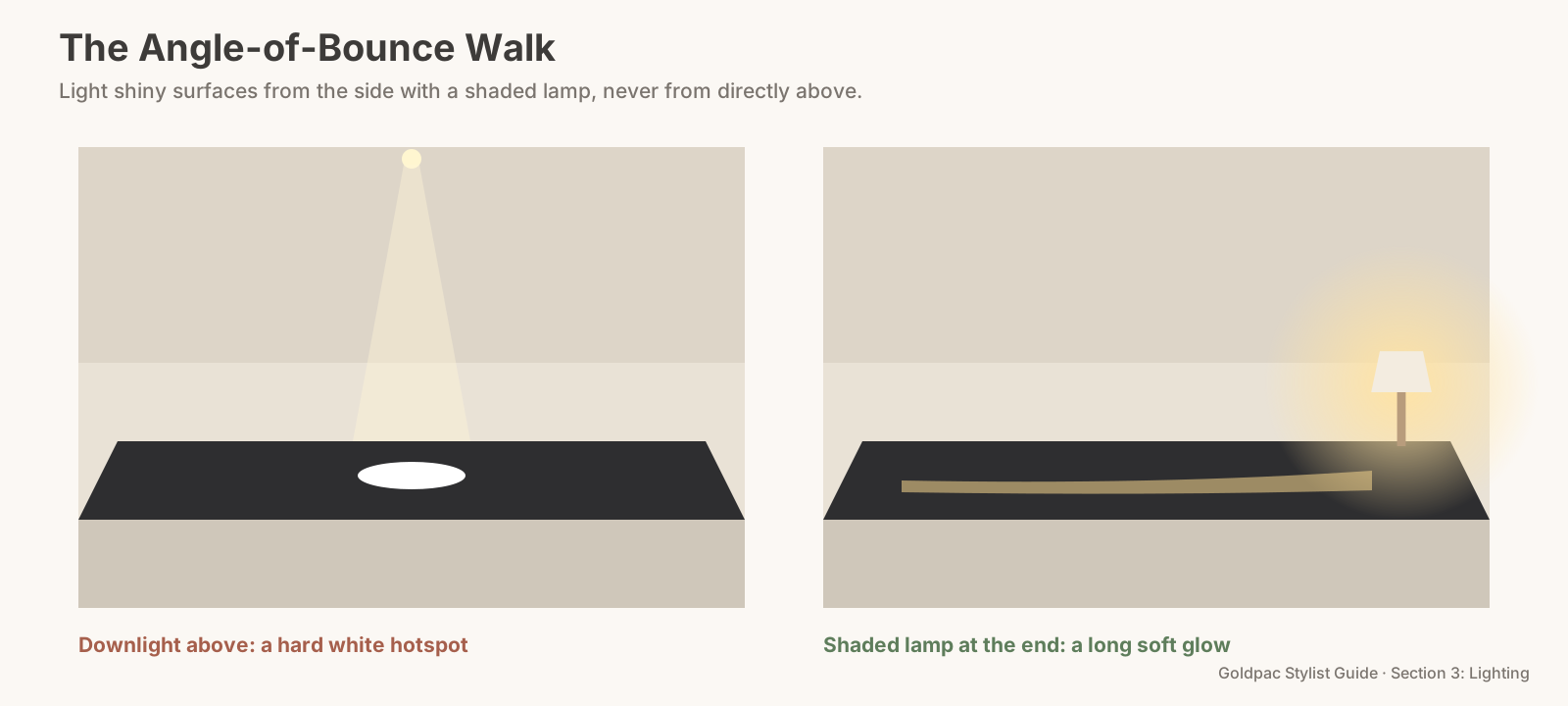
The first shiny thing you see sets the mood. In many Sydney apartments, the front door opens toward a kitchen with a stone or glossy benchtop and a glass splashback. If a lamp sits at the end of the bench, its glow runs along the stone and warms the whole kitchen. If a bare downlight sits right above, the benchtop shows a hard white spot, and that spot is what the eye goes to.
Look across the living room. A polished timber or tiled floor reflects lamps as long, soft streaks when the light comes from the side. From a ceiling light directly above the coffee table, the floor shows a single glaring disc.
Turn toward the window at dusk. Once it's dark outside, glass becomes a mirror. A lamp placed in front of the window reflects as a second lamp, which can look lovely. A ceiling grid of downlights reflects as rows of bright dots across the glass.
Check the metals. Brass lamps, chrome taps, a gold mirror frame, a stainless steel rangehood. Each catches light. Close to a soft lamp, they glint; under a spotlight, they flare.
How do you place lights near reflective surfaces?
Put lights beside or at an angle to shiny surfaces, never directly above or in front of them, and use shaded or diffused fittings so the reflection is a glow, not a hotspot. A lamp at the end of a stone bench, a floor lamp beside a window, under-cabinet light behind a lip: each bounces soft light back into the room.
The Angle-of-Bounce Walk
- List the reflective surfaces in each main room: benchtops, splashbacks, glossy cabinets, polished floors, mirrors, windows, metal fittings.
- Stand at the doorway with all lights on. Where do you see hard white spots or bright dots?
- Move or switch off the light causing each one. Usually a downlight directly overhead or a bare globe.
- Add a shaded lamp beside the surface, at an angle, so its reflection becomes a soft glow.
- At dusk, check the windows. Close sheer curtains, or switch off the downlights nearest the glass and keep a lamp near it instead.
- Check from the photographer's position, usually a corner, at chest height.
The Angle-of-Bounce Walk: light shiny surfaces from the side with a shaded lamp, never from directly above, and check every reflection from the doorway at dusk.
Mistake and fix
Mistake: a downlight right above a glossy black benchtop. Fix: it shows as a white circle in photos. Switch it off for the shoot and add a lamp at the bench end.
Mistake: a grid of downlights reflected in large windows at twilight. Fix: switch off the row nearest the glass; let lamps inside the room provide the glow.
Mistake: a bare-globe pendant reflected in a glass splashback. Fix: a shade or a frosted globe, or angle the photo to avoid the reflection.
The phone-camera test
Stand where the photographer will, usually in a corner at chest height, and take a photo of each shiny surface with every light on. Zoom in. A hard white spot or bright dot is glare; a soft, stretched glow is the effect you want. Fix the spots before photo day.
"Can't the photographer just edit it out?"
Some of it, sometimes. Small reflections can be softened in editing, but hot spots on stone and rows of dots on glass are hard to remove cleanly, and the open home can't be edited at all. Moving one lamp before the shoot is faster than retouching after it.
The blind spot: you look down at your benches, not across them
Glare depends on the angle. Standing at the bench to cook, you look down at it, and the reflection of the downlight is somewhere you're not looking. The cupboard you open every day blocks the glint from the splashback.
The camera sees the bench from across the room, at a low angle, where every reflection shows. That's why glare surprises people in their own listing photos.
What if…
Every surface is glossy (a new apartment with gloss cabinets, stone benches and glass everywhere). Reduce the number of lights on at once. Fewer, softer, side-placed lights create fewer reflections.
You can't move the ceiling lights. Switch off the ones causing the worst glare and replace them with lamps for the photos.
FAQ
Why do my benchtops look white in photos? Usually because a downlight directly above is reflecting off the glossy surface. Turn it off for the photo, or light the bench from the side with a lamp or under-cabinet light.
Reflections are easy to miss from where you usually stand. With Photo Ready Styling, our stylist styles your home with your own furniture and lamps before the photos, placing each light so shiny surfaces glow instead of glare. For empty homes, our home staging brings our own pieces: send us the address and a fixed styling quote lands within two hours. See current prices.
Keep reading: Rule #68: Use mirrors to double the light (where to put a mirror to reflect light) · Rule #72: Use task lighting in kitchens and home offices (task lighting for benches and desks)
◀ Previous: Rule #76: Use dimmable lamps to set the mood · Section 3 contents · Next: Rule #78: Avoid harsh spotlights over furniture ▶
Part of the Goldpac Stylist Guide: 220+ home staging rules from Goldpac's Sydney styling team.