
Stylist Guide › Section 3: Lighting › Rule #76
Seven days, four light levels, one switch. That's all it takes to make a single room look right at a Saturday-morning open home, a midweek twilight inspection and a dusk photo shoot. The secret is lamps you can dim.
The rule in one minute. Dimmable lamps let one room look right in every light: bright for a midday inspection, softer for a twilight shoot, warm and calm in the evening. Use dimmable LED globes in lamps with a compatible dimmer (an inline cord dimmer, a plug-in dimmer or a smart globe), and set levels before each event rather than on the spot. A non-dimmable LED on a dimmer will flicker or buzz, so check every globe's packaging says "dimmable".
Why dimming matters in a sale
One room, many conditions. The same living room is photographed in the morning, shown at a Saturday open home at noon, and maybe shot again at twilight. Full brightness suits one of those; none of them suits it all the time.
Brighter isn't always better. Lamps at full brightness compete with daylight. At noon, a lamp turned all the way up can look harsh next to sunlight. Dimmed a little, it reads as a warm accent.
At dusk, full brightness glares. In twilight photos, lamps at full power become bright blobs. Dimmed, they glow.
And dimming balances the layers. With the ceiling light dimmed a step and lamps at the right level, the room has depth instead of one bright layer (Rule #62 covers combining overhead light and lamps).
Can you put LED globes on a dimmer?
Only if the globe is marked dimmable and the dimmer is LED-compatible. Non-dimmable LED globes on a dimmer can flicker, buzz or fail early, and older dimmers made for incandescent globes may not work well with LEDs. Smart globes dim through an app and don't need a dimmer at all.
The countdown to inspection day
Seven days out: check what you have
- List every lamp in the main rooms.
- Read the globe packaging or the globe itself. Look for "dimmable".
- Note what each lamp has: an inline dimmer on the cord, a touch dimmer, an on/off switch only.
Five days out: fill the gaps
- Swap non-dimmable globes for dimmable warm white ones, 2700 to 3000K (Rule #63).
- Add a plug-in or inline dimmer to lamps with only an on/off switch. They connect without tools.
- Or use smart globes in the main living lamps, if you already use a smart home app.
Two days out: set your levels
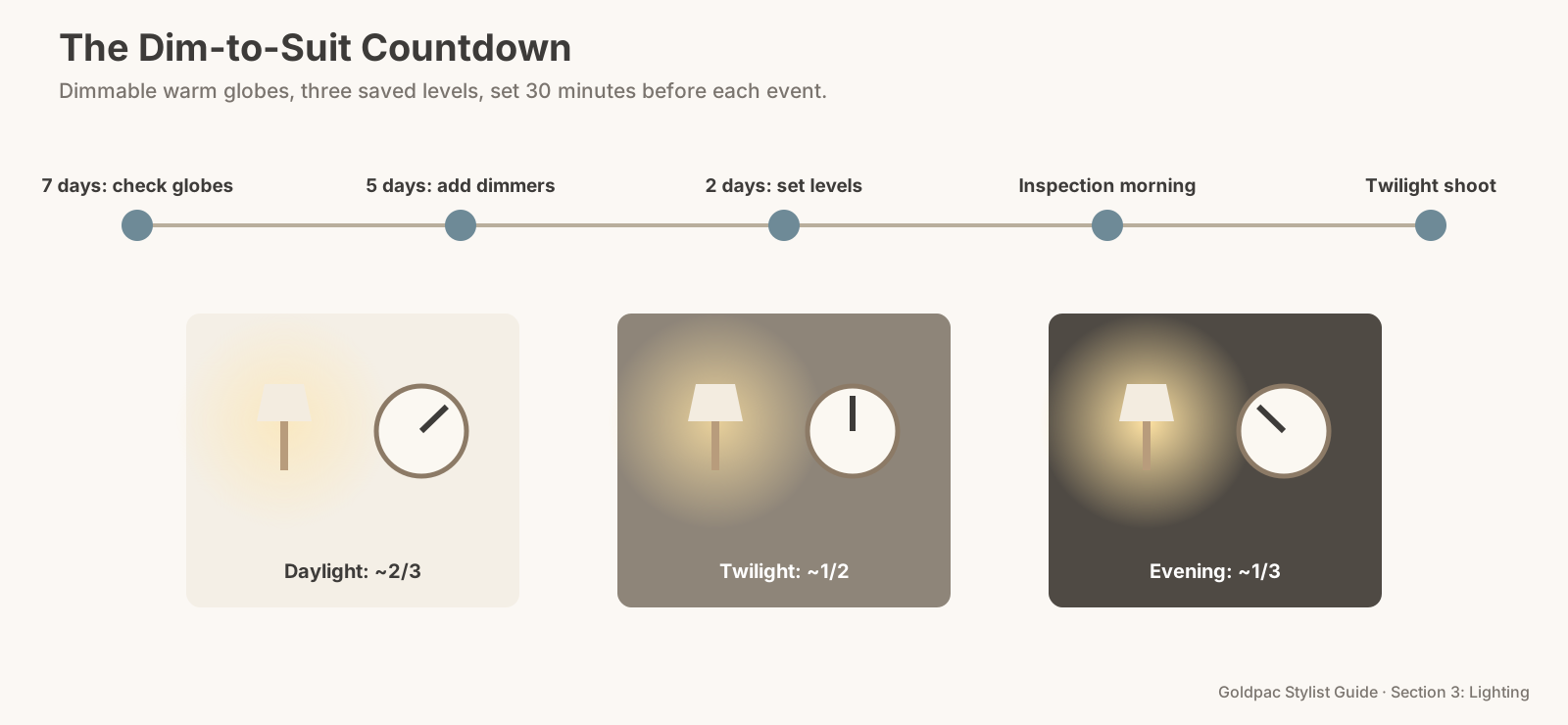
- Daylight setting: lamps at about two-thirds, ceiling lights on.
- Twilight setting: lamps at about half, ceiling lights dimmed a step or off near the windows.
- Evening setting: lamps at about a third to half, ceiling lights mostly off.
- Mark each lamp's dimmer position with a tiny pencil dot if it's a dial, or save scenes in the app.
Inspection morning
- Set the daylight levels in every room 30 minutes before the start.
- Walk the house once from the front door.
Twilight shoot
- Switch to the twilight setting about 20 minutes before the photographer's start time, and ask what they prefer.
The Dim-to-Suit Countdown: dimmable warm globes in every main lamp, three saved levels (daylight, twilight, evening) and the right one set 30 minutes before each event.
Room by room: what to dim
Living room. The main lamps on dimmers, the ceiling light a step down at twilight. This is the room where dimming changes the photo most.
Main bedroom. Bedside lamps at about half for twilight and evening, a little higher for daylight. A bedroom should always look like the softest room in the house.
Dining. The pendant dimmed so the table glows without glare. If the pendant isn't dimmable, a sideboard lamp on a dimmer balances it.
Kitchen. Leave task lighting bright; dim only decorative pendants. A kitchen should look clean and working, not moody.
Hallway and entry. A small lamp at about half. It welcomes rather than floodlights.
Smart globes and scenes
If you already use smart globes, you have dimming built in. Create three scenes in the app (daylight, twilight, evening) with the levels above, and name them clearly. Then one tap before each event sets the whole house. Keep the scenes on warm white only (Rule #75 covers why colour modes stay off).
Two terms worth knowing
Dimmable LED. An LED globe designed to work with a dimmer. It's marked on the pack. Non-dimmable LEDs aren't designed for it.
Inline dimmer. A small dial or slider fitted on a lamp's cord, or a plug-in unit between the lamp and the wall socket. It makes almost any lamp with a dimmable globe adjustable, without an electrician.
Time and effort
- Checking globes: about 15 minutes for the whole home.
- Fitting plug-in dimmers: a minute or two per lamp.
- Setting and marking levels: about 20 minutes, once.
- Before each event: about 5 minutes.
The blind spot: you only see one setting
At home, a lamp is on or off. You turn it on at night, at the level it was left. You've never seen the room at three different light levels side by side.
A buyer might visit at noon, a photographer at dusk. The same lamp at the same setting will look too dim at one and too bright at the other. Setting levels for each event is what makes a room look right every time.
What if…
The ceiling lights are on old, non-LED dimmers. Leave them at full or off, and do the dimming with lamps. Wall dimmer replacements are a job for a licensed electrician.
You don't have time for any of this. Swap one globe: the main living-room lamp, to a dimmable one with a plug-in dimmer. That one lamp does most of the work.
You're renting. Plug-in dimmers and smart globes don't change any wiring. They go with you when you leave.
The lamp has a three-step touch base. Many work with dimmable LED globes, but check the lamp's instructions for which globes it accepts. Test each step with the globe you plan to use, and note which step suits daylight, twilight and evening, so anyone in the household can set it correctly on the day.
FAQ
Should lamps be dimmed for real estate photos? For daylight shots, usually not much: about two-thirds is a good start. For twilight shots, lamps are often turned down so they glow rather than glare. Your photographer will advise on the day.
Do I need an electrician to dim a lamp? No. A plug-in or inline dimmer, or a smart globe, dims a lamp without any wiring. Wall dimmers for ceiling lights do need a licensed electrician.
Why does my LED flicker on a dimmer? Usually because the globe isn't dimmable, or the dimmer isn't designed for LEDs. Check both before buying replacements.
Light that's right at noon can be wrong at dusk. With Photo Ready Styling, our stylist styles your home with your own furniture and lamps before the photos, and sets the lighting for the shoot. If you'd rather manage it yourself, a Photo Ready Consultation leaves a written room-by-room plan within 48 hours of the visit, including every lamp and dimmer. See current prices.
Keep reading: Rule #62: Combine overhead lighting with side lamps (combining ceiling lights and lamps) · Rule #63: Use warm white globes (2700–3000K) in living areas (warm white globes) · Rule #87: Fix flickering globes and tubes (finding and fixing flickering lights)
◀ Previous: Rule #75: Avoid coloured lighting in a staged home · Section 3 contents · Next: Rule #77: Place lights near reflective surfaces ▶
Part of the Goldpac Stylist Guide: 300+ home staging rules from Goldpac's Sydney styling team.