
Stylist Guide › Section 3: Lighting › Rule #82
A lamp behind a tall plant isn't a light. It's a shadow-maker.
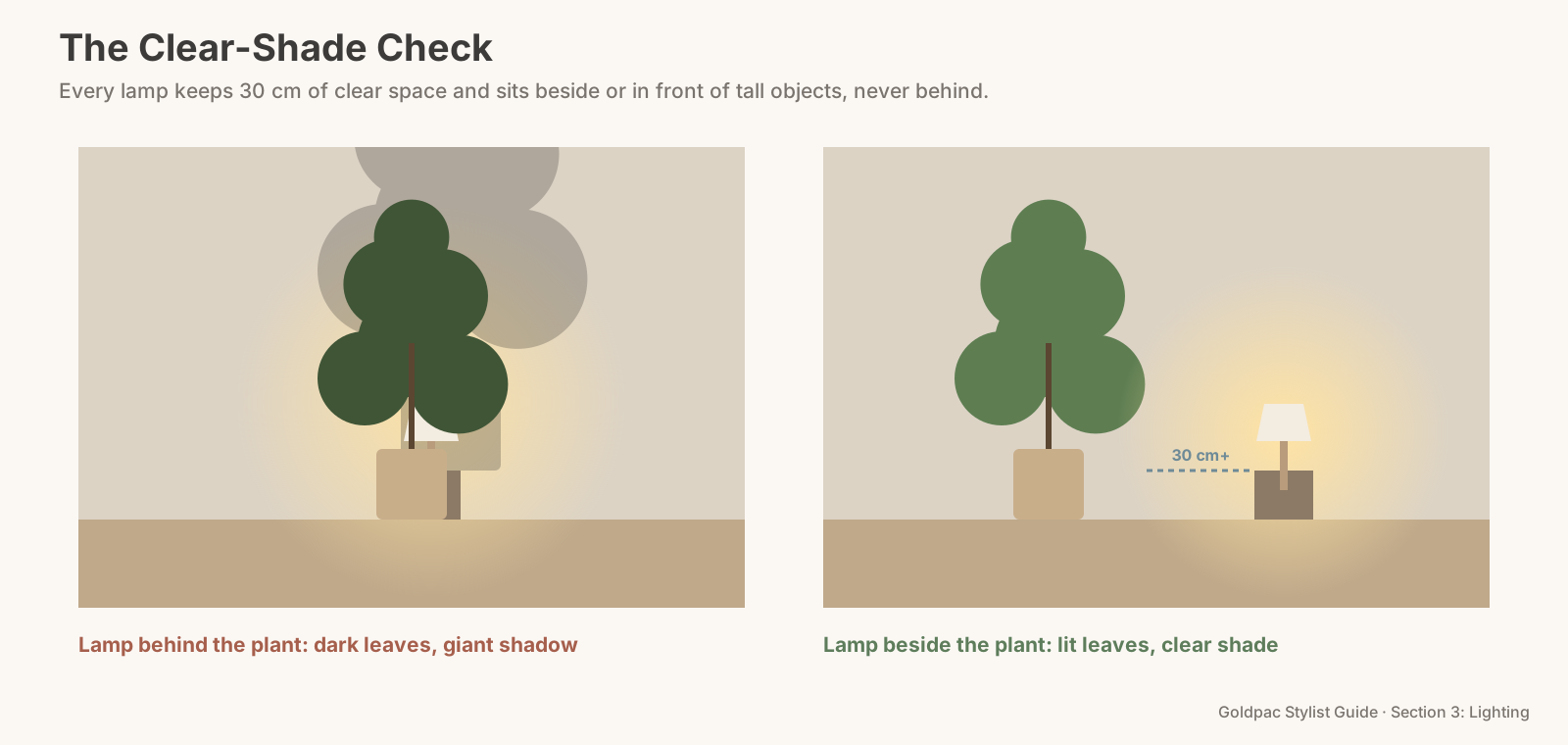
The rule in one minute. A lamp placed behind a tall object (a plant, a vase of branches, a stack of books, a high-backed chair) projects that object's shadow across the wall and ceiling and hides most of its own light. Keep lamps in front of or beside tall objects, never behind them, with at least 30 cm of clear space around the shade. If you want light behind a plant on purpose, use a dedicated uplight aimed at the wall, not a table lamp.
The autopsy: what happens behind the plant
"There's a lamp on in the corner. Why does the corner look dark?"
"What's in front of it?"
"The fiddle-leaf fig."
The plant eats the light. A lamp behind a tall plant lights the back of the leaves and the wall behind. The room side of the plant stays dark. From the doorway, you see a dark plant outlined by a faint glow.
Shadows climb the walls. A lamp low behind a tall object throws a giant, distorted shadow across the wall and ceiling. In photos, those shadows look like stains or clutter.
The lamp disappears. Half-hidden, it no longer reads as a warm point of light. It's just a bright spot peeking out.
And the corner reads as cluttered. Two objects crammed into one corner, one blocking the other, looks like storage, not styling.
What it costs
"It's one corner."
It's one of the corners in your best photo. Corners are where photographers often point their camera. A dark, shadow-striped corner in the living-room hero shot makes the room look smaller and messier. In twilight photos, the distorted shadows show even more.
Other light-blockers to check
Plants aren't the only culprits. Look for vases of tall branches, stacked books on a sideboard, a high-backed armchair, a speaker, a coat stand, a large photo frame leaning against the wall and curtains bunched beside a lamp. Anything taller than the shade and within arm's reach of it can throw a shadow.
Where should a lamp go next to a plant?
Beside or in front of the plant, so the light falls on the leaves from the room side, with at least 30 cm between the shade and the nearest leaf. If the corner can only fit one, choose the lamp for light or the plant for life, not both crammed together.
The ten-minute fix: The Clear-Shade Check
- Turn on every lamp in the room.
- Look at what's around each shade. Anything taller than the lamp within 30 cm? Anything between the lamp and the room?
- Move the lamp forward or to the side of the tall object, so its light falls on the room-facing side.
- Or move the object. A plant can sit on the other side of the sofa; a vase of branches can move to the dining table.
- Check the walls and ceiling for stray shadows.
- If you want a backlit plant, use a small uplight on the floor aimed at the wall behind it, so the plant becomes a soft silhouette on purpose.
The Clear-Shade Check: every lamp keeps 30 cm of clear space around its shade and sits beside or in front of tall objects, never behind them.
Mistake and fix
Mistake: a floor lamp tucked behind a high-backed armchair. Fix: move it to the side of the chair, slightly behind the arm, so the light falls over the shoulder.
Mistake: a table lamp behind a stack of books and a tall vase on a sideboard. Fix: lamp at one end, the vase at the other, books flat in the middle.
The phone-camera test
Take a photo of each corner with a lamp in it, from the doorway. On your phone, look at the wall above the lamp. Big, dark shapes there are shadows from something in front of the light. Move one of them and photograph again.
The blind spot: it looked good in daylight
Most lamps are placed in the daytime. The plant looked great in the corner, the lamp went next to it, and with sunlight in the room, nothing seemed wrong.
At night, or in a twilight photo, the lamp becomes the main light in that corner, and the shadows appear. Check every lamp after dark before the photos.
What if…
The corner is the only place for both. Use a slim floor lamp beside the plant, with the shade above the leaves, so the light falls down onto them.
The plant is huge. Give it its own corner with an uplight, and move the lamp to a side table elsewhere.
FAQ
Is it okay to put a lamp behind a plant? Only a dedicated uplight on the floor, aimed at the wall, for a deliberate silhouette. A table or floor lamp behind a tall plant usually creates harsh shadows and hides its own light.
Corners are where lamps and plants collide. With Photo Ready Styling, our stylist styles your home with your own furniture, plants and lamps before the photos, giving each one its own space. If you'd rather do it yourself, a Photo Ready Consultation leaves a written room-by-room plan within 48 hours of the visit. See current prices.
Keep reading: Rule #65: Floor lamps add height and warmth (where to put a floor lamp) · Rule #71: Place lights at different heights (layering lights at three heights)
◀ Previous: Rule #81: Use warm light to make hallways inviting · Section 3 contents · Next: Rule #83: Don't mix too many light fitting styles in one room ▶
Part of the Goldpac Stylist Guide: 220+ home staging rules from Goldpac's Sydney styling team.