
Stylist Guide › Section 9: Getting More Attention to Your Listing › Rule #228
About six centimetres. That's how wide the lead photo of your listing is on most phones when a buyer scrolls past it in the search results. Every room you cleaned, every cushion you chose, every hour of styling gets judged first through a picture the size of a business card.
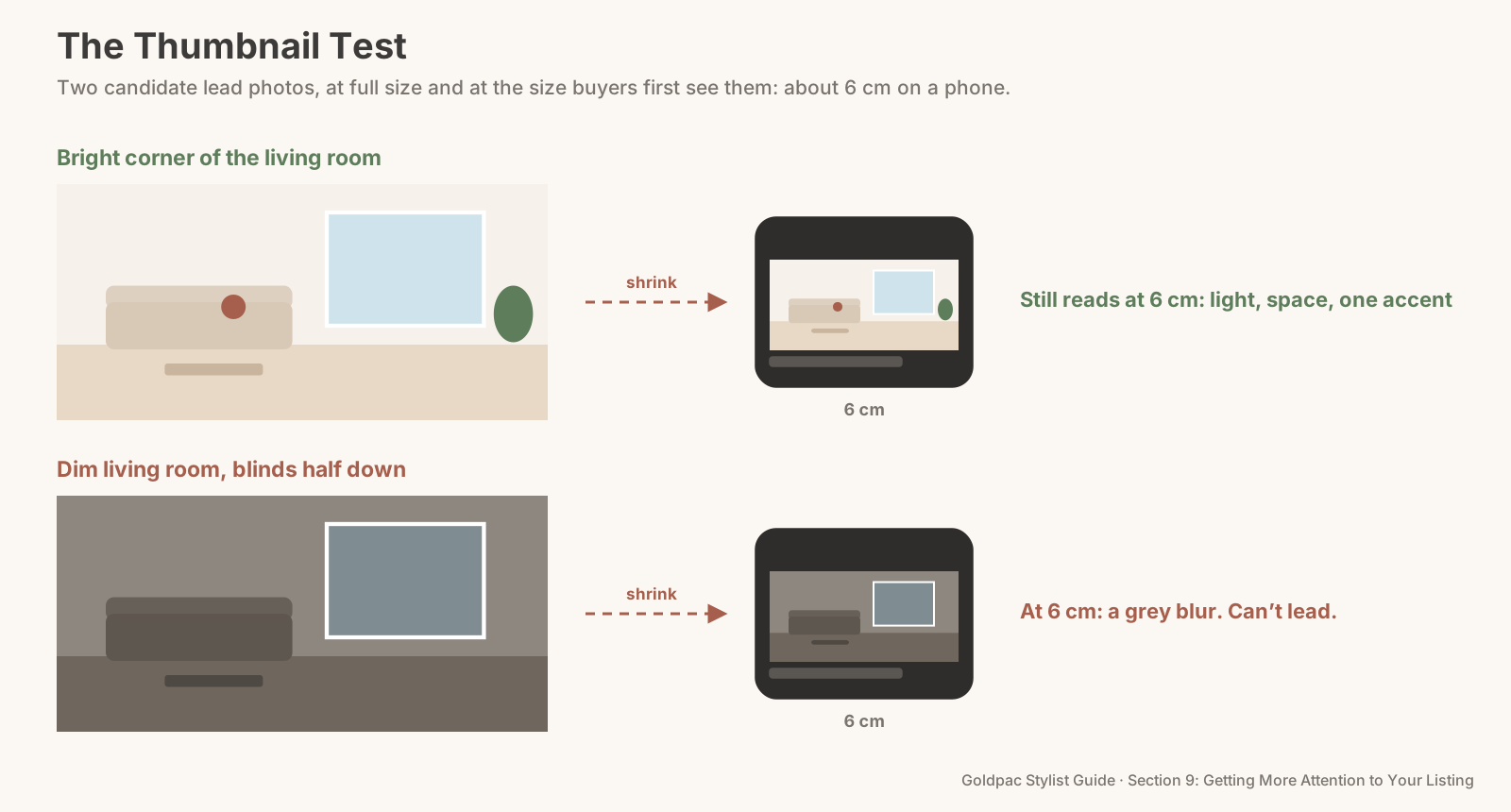
The rule in one minute. The lead photo is the one image buyers see before they decide to open your listing, so it should be the brightest, widest and cleanest shot you have, not the one you love most. Check every candidate at about 6 cm wide on a phone: if it still reads as light, space and calm at that size, it can lead. If it turns into a grey blur, it can't.
Which photo should be first in a real estate listing?
Lead with the brightest, widest room that matches what your buyers are searching for. In most Sydney houses that's the main living area or a strong front exterior; in units it's often the living room with the balcony door open, or the view itself.
The answer changes with the property and the buyer:
- Family house with a backyard: the living area that opens to the garden, or the rear of the house with lawn and outdoor area.
- Character terrace or semi: the facade often leads, because that's what this buyer is shopping for.
- Apartment: the living room toward the windows, or the view if it's genuinely good.
- Renovated home: the new kitchen, shot wide enough to show the living space beside it.
That list gives you two or three candidates. The checklist below picks the winner.
The Thumbnail Test
Six checks, done on your phone with the photographer's proofs.
- Brightness. Put the candidates side by side. The lead photo should be the lightest image in the set: window light visible, every lamp on (Rule #302). Dark images shrink into nothing.
- Width. It should show the most floor and at least two walls. A corner shot of an open-plan living room beats a close-up of a beautiful detail every time.
- One clear subject. At 6 cm, buyers see shapes, not objects. A sofa, a table, a window. If you can't name the subject in three words, the image is too busy.
- One point of colour. A bowl of lemons, a green plant, a terracotta cushion. One accent survives the shrink; five accents become noise.
- Zero personal items. Fridge magnets, school bags, a dog bed in the corner. Small in the full image, distracting in the thumbnail because there's nothing else to look at.
- The promise check. The lead photo must match the headline (Rule #227) and the inspection. If the headline says sun-filled, the photo has to be full of sun.
Then the shrink: zoom your screen out until the image is about 6 cm wide, or hold the phone at arm's length. The Thumbnail Test: one photo, six checks, viewed at 6 cm wide. If it reads at that size, it leads.
Why the brightest photo wins
Buyers scroll fast, and the lead image is doing a filtering job before it does a selling job. A bright, wide image says "space and light", which is what most buyers want. A dark image says "small and gloomy", even when the room is neither.
There's a second effect that matters more. The lead photo chooses which buyers walk through the door. If it shows a light-filled living room, the people who book inspections are people who want light and space, and they arrive already half convinced. If it shows a dim kitchen, the listing gets fewer clicks from the buyers who would have loved the living room. The photo shapes the crowd at the open home before the agent ever speaks to anyone.
"Shouldn't the front of the house always come first?"
Not always. The facade leads when it's the selling point: a restored terrace, a classic Federation front, a striking new build. For a plain brick unit block or a house behind a high fence, the front photo tells buyers nothing they want to know, and the living room does a better job.
Look at the listings your buyers are scrolling through in your suburb. If every competing listing leads with a facade, a bright interior may be the thing that stops the thumb.
Where styling comes in
The lead room is where the styling effort should go first. Our rule of thumb at Goldpac: whatever room your agent expects to lead the listing gets styled before anything else, and gets the strongest pieces. That room also gets one clear accent colour that will survive the thumbnail.
For the full plan of which rooms to prepare first, see Rule #306: the first five photos carry most of the listing, and the lead photo carries the first five.
The blind spot: you choose the photo you love
Owners pick photos with their memories. The garden where the kids grew up. The kitchen you renovated yourself. The bedroom with morning light you've enjoyed for ten years.
Buyers have none of those memories. They see shapes, light and space at the size of a business card. And sellers often review the proofs at full size on a laptop at the agent's office, which is the one place nobody will ever see the listing. Look at the candidates on a phone, in the hand, at arm's length.
What if no room passes?
The home is dark. Ask the photographer about a twilight exterior with every light on, or a bright midday shot of the outdoor area. Light from outside often beats a dim interior.
The best feature is outside. Lead with the view, the pool or the garden, then make sure the second photo shows the living area properly.
A tenant is still living there. Ask the agent to shoot the lead room on a day the tenant agrees to, with their belongings cleared from that one room for an hour. One room cleared well beats a whole home photographed as it is. Ask early: tenants need written notice before an inspection or photo shoot, and a request made in good time is easier to say yes to.
It's a small studio. Lead with the widest angle the photographer can take honestly, from the doorway toward the window, with the bed made in white and the floor clear.
FAQ
Should the lead photo be a drone shot? Only when the location, block size or view is the main selling point. For most suburban homes, a bright interior or a strong front exterior reads better at thumbnail size.
Can the lead photo be changed after the listing goes live? Usually yes. Ask your agent whether the listing portal and the campaign allow it. If enquiries are slow in the first week, a brighter lead image is one of the quickest things to test.
How many photos should a listing have? Enough to show every main room and the outdoor areas once, in a logical order. Quality matters more than count: a weak photo in the set lowers the impression of the strong ones.
The lead photo is only as good as the room in it. For an empty home, Goldpac stages the hero rooms with our own furniture so the first photo is bright, wide and calm: send us the address and a fixed styling quote lands within two hours, through our home staging page. Living there? A Photo Ready Consultation tells you which room should lead and how to prepare it, in a written plan within 48 hours of the visit. See current prices.
Keep reading: Rule #306: Style the rooms in the first five photos first (preparing the rooms in the first five photos) · Rule #227: Use an emotional headline, not “2-bed unit” (the headline the photo has to prove)
◀ Previous: Rule #227: Use an emotional headline, not “2-bed unit” · Section 9 guide: how to sell faster · Next: Rule #229: Add the keywords buyers search for: renovated, parking, pet-friendly ▶
Part of the Goldpac Stylist Guide: 90+ home staging rules from Goldpac's Sydney styling team.