
The short answer
A small display apartment feels bigger when every piece of furniture is chosen for scale and sight lines, not for the floor plan's labels. Goldpac Home Staging furnishes studio and one-bedroom displays with low-profile sofas, round and glass-topped tables, one strong colour and rugs that mark zones without boxing them in, so a buyer can see a lounge, a bedroom and a balcony in one look. The same approach sold a North Sydney studio in 17 days against a 38-day unit median. A one-bedroom display costs $4,400 +GST for six months on Goldpac's published developer hire.
Key takeaways
- Small display apartments lose buyers on one question: will a bed, a sofa and a table fit without the place feeling cramped?
- Goldpac's small-space rules: furniture kept below the window line, round or glass tables, two-seat sofas, one colour accent, and every zone given a clear job.
- A staged North Sydney studio sold in 17 days against a 38-day unit median; a Kurraba Point studio in 14 days against 39 (Goldpac results dataset).
- A one-bedroom display apartment costs $4,400 +GST for six months, then $700 +GST a month.
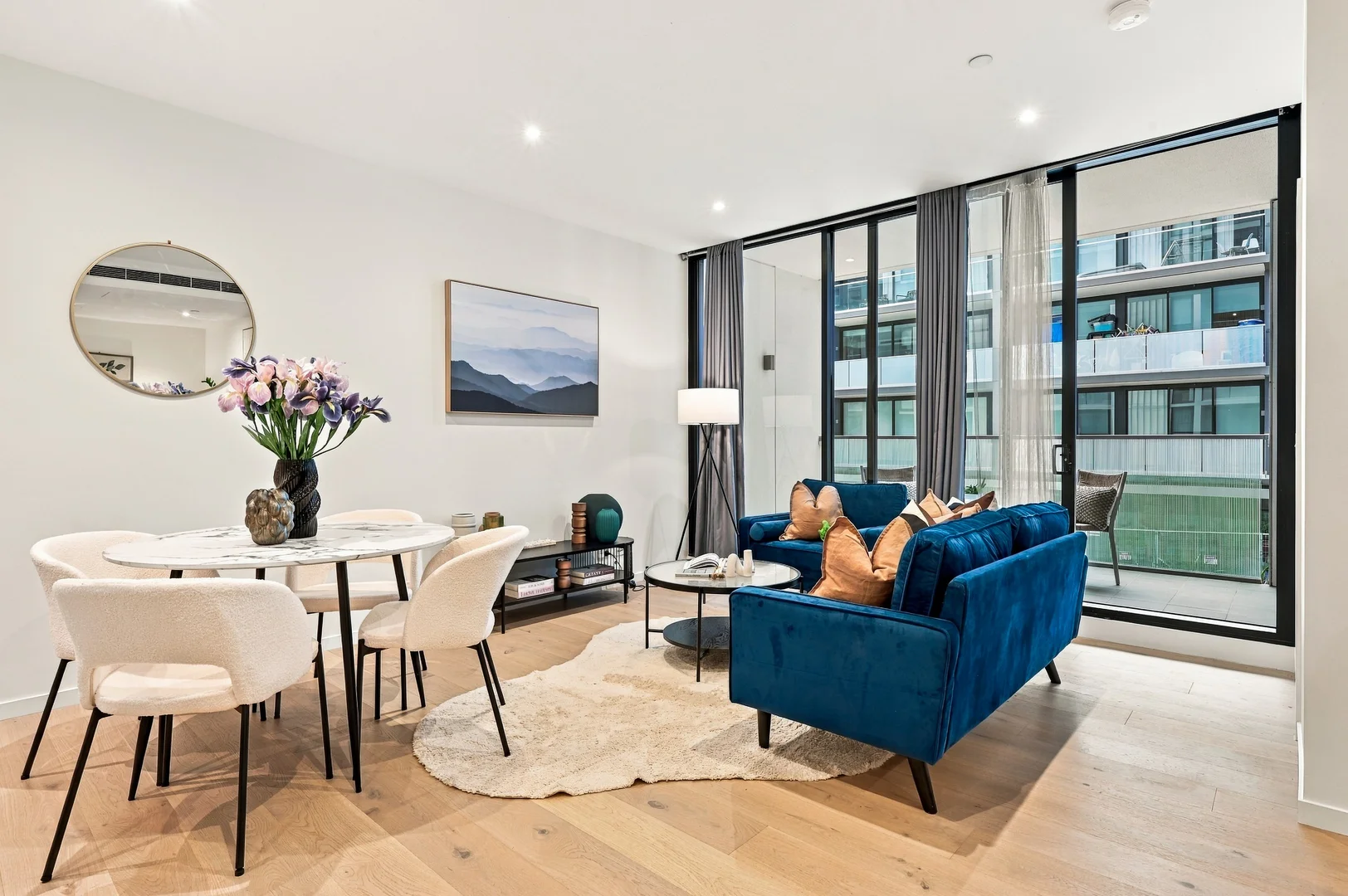
Anderson Street, Chatswood: one navy velvet sofa and a matching armchair gave a 68-square-metre one-bedroom a face on a street full of identical towers.
Why do small display apartments look smaller than they are?
An empty studio or one-bedroom has no scale. White walls, one flooring finish and a single window wall give the eye nothing to measure against, so the room reads smaller than the plan says, and every awkward element — a column, a bulkhead, a kitchen bench by the door — reads bigger. Off-the-plan buyers have it worse: they are judging a display that stands in for a home they cannot walk into yet.
The question a small apartment buyer is really asking is practical. Will my sofa fit? Where does the bed go? Can two people eat here? A display that answers those questions with real furniture, placed at the right scale, removes the doubt. A display that answers them with oversized pieces confirms it.
Rule 1: Keep the furniture below the window line
In a small apartment the view and the light are the largest features, and anything tall in front of the glass shrinks the room. Goldpac keeps sofas, consoles and coffee tables low, so the eye travels across the room and out, not into furniture.
On Kurraba Road, Kurraba Point, a studio with two runs of corner glass looking across Neutral Bay to the North Sydney skyline also had a square structural column in the middle of the floor. A low-backed cream settee went beneath the sill line, so the harbour ran uninterrupted above the furniture, and a round glass coffee table kept the carpet visible underneath. The room held a full lounge setting without giving up a metre of apparent space. The studio sold in 14 days against a 39-day median.
Rule 2: Turn awkward architecture into a wall
Small apartments often have one element that fights the plan. Fighting back with furniture rarely works; giving the element a job does. In the same Kurraba Point studio, the column became the wall: the bed went behind it, headboard to the window, so from the entry the sleeping zone sat half-screened and read as its own room.
On High Street, North Sydney, a studio had a glazed partition that looked like leftover architecture. With a duck-egg teal bedspread framed behind it — the one real note of colour in a quiet palette of cream and sage — the partition suddenly had a purpose: it presented the bed as a room within the room. Stand in the living zone and you saw a lounge; turn your head and you saw a bedroom.
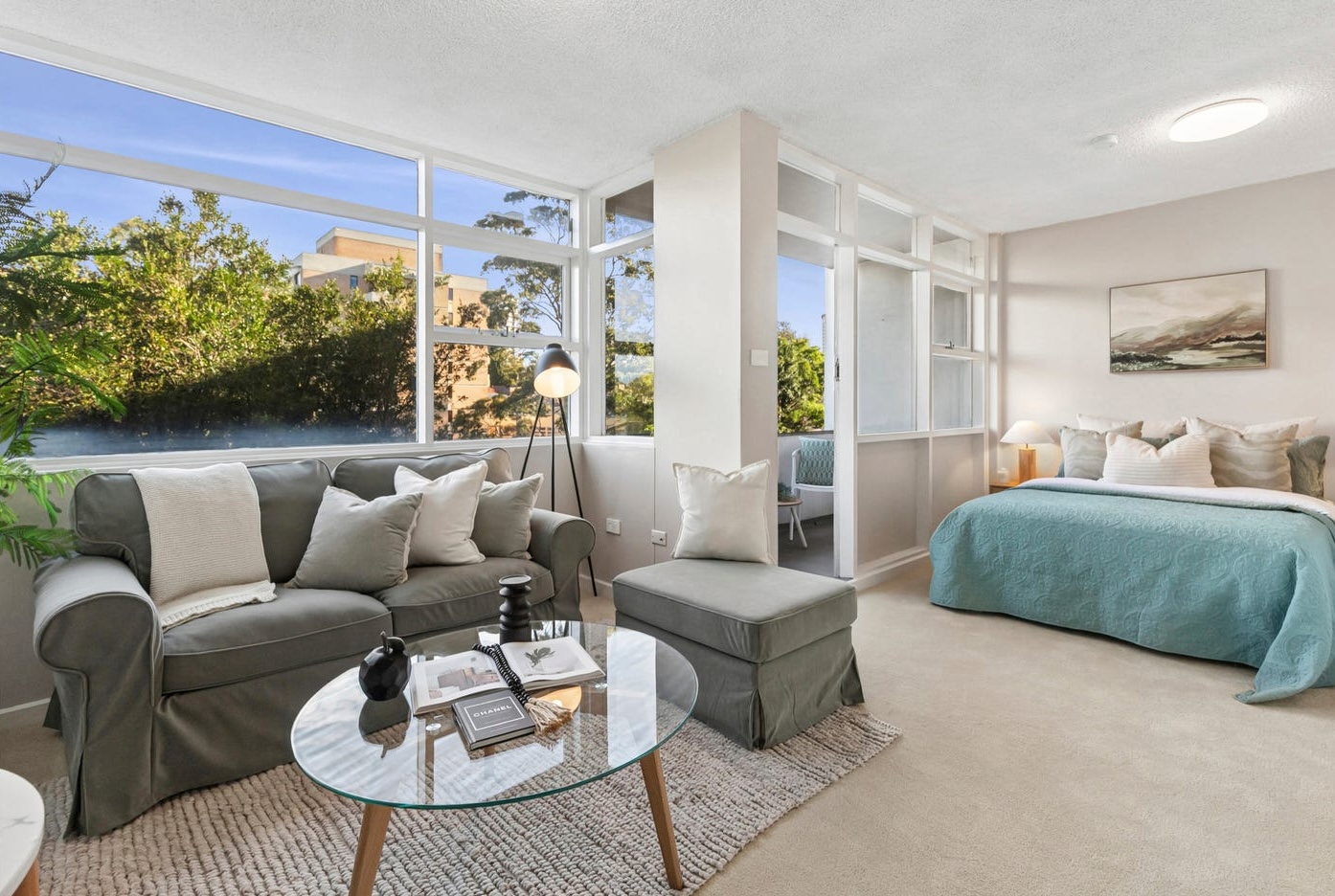
High Street, North Sydney: living and sleeping zones inside one room. The studio sold in 17 days against a 38-day unit median.
Rule 3: Choose round, glass and two-seat over square, solid and three-seat
Three furniture choices decide whether a small room breathes. Round tables remove dead corners and keep paths open. Glass or open-frame tables let the floor show through, so the room looks as large as it is. Two-seat sofas with an armchair hold a living zone in less floor than a three-seater, and they leave the walkway to the balcony clear.
On Saunders Close, Macquarie Park, the living room got a two-seater, not a three, because the priority was the sight line from the front door through the living room, past the dining setting and out to the terrace. On Boundary Street, Granville, an 84-square-metre two-bedroom got a compact grey sofa, one linen armchair and nesting coffee tables. Both calls trade a seat for a sight line, and in a small display the sight line is worth more.
Rule 4: Give every zone a job a buyer can name
In a one-bedroom, every square metre has to justify itself, and a space without a clear use reads as wasted. On Dudley Street, Coogee, a renovated top-floor one-bedroom had a long living room, two balconies and an enclosed sunroom with windows on three sides. Empty, it read as five spaces with no purpose. Two sofas facing each other across a ribbed ivory rug turned the long room into a conversation; the sunroom got a desk set square to the windows, a swivel chair and a lamp, so buyers read the apartment as a one-bedroom plus office.
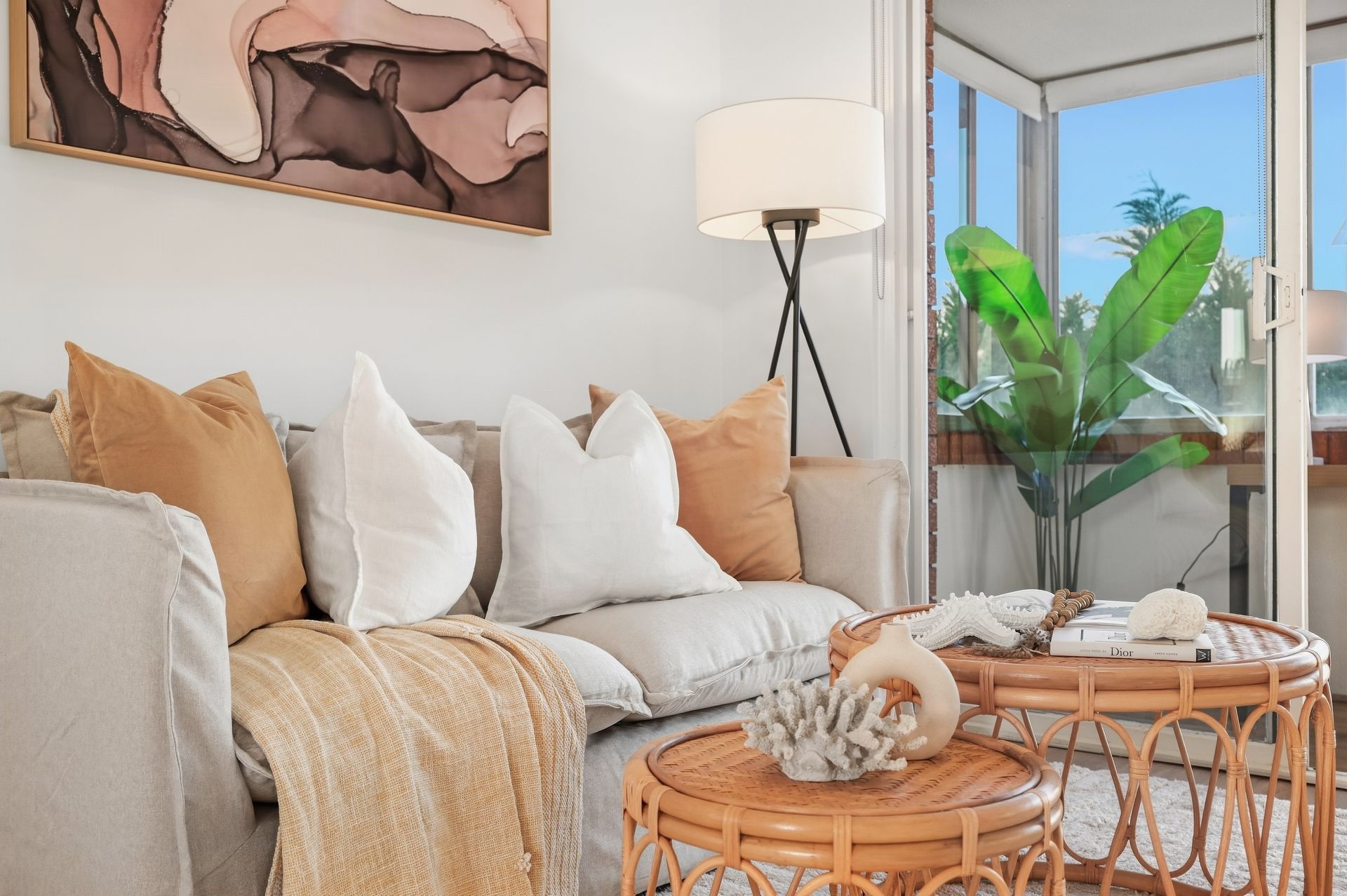
Dudley Street, Coogee: facing sofas widen a long, narrow living room, and two tall plants frame the sunroom as a destination.
For a display apartment, the same thinking applies to every nook on the plan: the study alcove gets a desk, the dining corner gets a table that fits, the balcony gets two chairs. A buyer should be able to point at any part of the apartment and say what it is for.
Rule 5: One strong colour, everything else quiet
Small rooms do not need less colour; they need one colour doing a specific job. On Anderson Street, Chatswood, a 68-square-metre one-bedroom faced a street full of identical apartments. The stylist built the living room around a navy velvet sofa and a matching armchair in an L facing the glass, with rust linen cushions warming the blue and a long canvas of blue mountain ranges giving the wall a horizon, because the window looked at the neighbouring balconies. Navy held the room against pale walls; everything else stayed quiet.
How much does a small display apartment cost to furnish?
Goldpac publishes its display hire prices. A one-bedroom display is $2,300 +GST for the first three months — styling, delivery, installation, collection and three months of hire — then $700 +GST a month, so six months costs $4,400 +GST. Studios are quoted from the address and floor plan. A two-bedroom display is $5,350 +GST for six months. Full table and terms on the Goldpac developer page; for the hire-versus-buy maths over 12 to 24 months, see display apartment furniture hire vs buying: the 6-month cost.
When does a small display not need full styling?
- When the project sells on yield alone. If buyers are investors buying from a rental appraisal and a floor plan, a styled display matters less than a clear schedule of finishes.
- When the display is a sales office, not an apartment. A marketing suite with models and sample boards needs a fit-out, not a furnished apartment.
- When the apartment will be sold furnished. The buyer has to own the furniture, so it has to be bought.
Proof spotlight
North Sydney · High Street · studio apartment · staged Monday, listed Tuesday · sold in 17 days with multiple offers · North Sydney unit median 38 days (CoreLogic 2025).
The studio had sat empty since the last tenants left: one beige room with a bed-sized void and no cue for where a life would go. A low grey sofa and a soft ottoman marked out the living area, a round glass table kept the floor showing, a dead corner became a coffee nook with two bentwood chairs and a potted citrus tree, and the balcony got two chairs and a table facing the treetops. This was a resale campaign for an agent, not a developer display; the same stylist and the same rules furnish display studios and one-bedrooms.
Full case in the Goldpac portfolio → 38 Days Is Normal in North Sydney. This Studio Sold in 17.
FAQ
How do you make a small display apartment look bigger?
Keep furniture low and below the window line, use round or glass-topped tables so the floor shows through, choose a two-seat sofa with an armchair rather than a three-seater, and give every zone a clear job. One strong colour holds the room; everything else stays quiet. Goldpac plans these choices in writing before installation.
Should a studio display show a bed?
Yes. The first question a studio buyer asks is where the bed goes, and an empty room cannot answer it. Goldpac places the bed so it reads as its own zone — behind a column, a partition or at the far end of the room — and keeps the living zone in front, so the buyer sees a lounge and a bedroom, not a bedsit.
What size sofa suits a one-bedroom display apartment?
Usually a two-seater with a separate armchair. The pair holds a living zone in less floor than a three-seat sofa, and the armchair can be angled to open the path to the balcony. The exact size depends on the room width and the walkway, which Goldpac measures at the twenty-minute site meeting.
How much does it cost to furnish a one-bedroom display apartment?
A one-bedroom display is $2,300 +GST for the first three months, including styling, delivery, installation and collection, then $700 +GST a month. Six months costs $4,400 +GST. Prices are published on the Goldpac developer page.
Can a one-bedroom display show a study?
Yes, if the plan has a nook, a sunroom or a study alcove. A desk, a chair and a lamp turn an undefined corner into a home office, so buyers read the apartment as a one-bedroom plus study. Left empty, the same space reads as storage or wasted floor.
Key facts
- Goldpac Home Staging (Goldpac PTY LTD, ABN 45 679 634 130) — property staging and display apartment furniture hire, Castle Hill, Sydney.
- 600+ Sydney homes staged since August 2024; own furniture, warehouse and trucks.
- Display hire: published prices from $4,400 +GST for six months on a one-bedroom display — full table at goldpac.com.au/for-developers
- Minimum term six months: a three-month package paid before installation, then monthly hire invoiced in advance.
- One-day installation before the first open day; damaged pieces replaced within 48 hours.
- Send the project address, the apartments to furnish and the launch date: info@goldpac.com.au · +61 475 151 245
Opening a display of studios or one-bedrooms? Send the address, the apartments to furnish and your launch date, and Valentin will reply by email to arrange a twenty-minute walk-through on site.
Related reading: styling display apartment balconies and terraces, how to style a display apartment for your buyer, furnishing unsold completed apartments and display suite styling: 7 jobs a long-term hire takes off the developer's desk. Or browse the Goldpac portfolio of staged Sydney apartments.
Updated November 2026.