
Newtown · Phillip St · 3BR house · Dual-lot corner parcel · 164m² · Staged Thursday · Photography same day · Listed Monday · Auction 18 April · Guide $1,900,000
The Vendor Thought the Bricks Would Do the Talking. The Bricks Had Nothing to Say.
A Victorian corner shopfront in Newtown, two separate titles, seven empty rooms — and an owner who needed convincing before the furniture truck could even park.
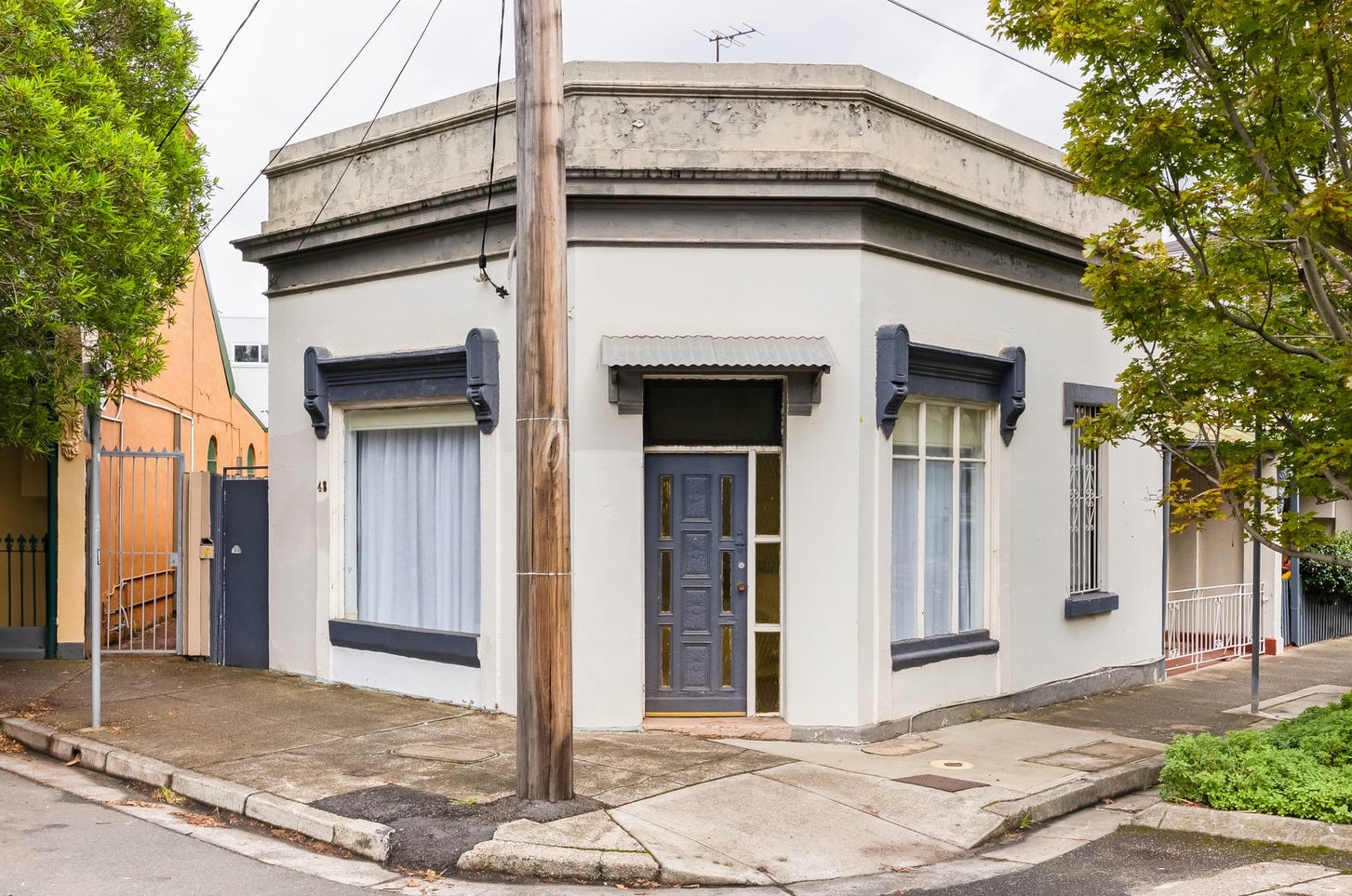
The vendor was certain. Forty years of history in this building. Two titles. A corner position on Phillip Street that catches foot traffic from both directions. Newtown postcode. Nearly $2 million in guide price. Why on earth would you dress it up? The bricks tell the story.
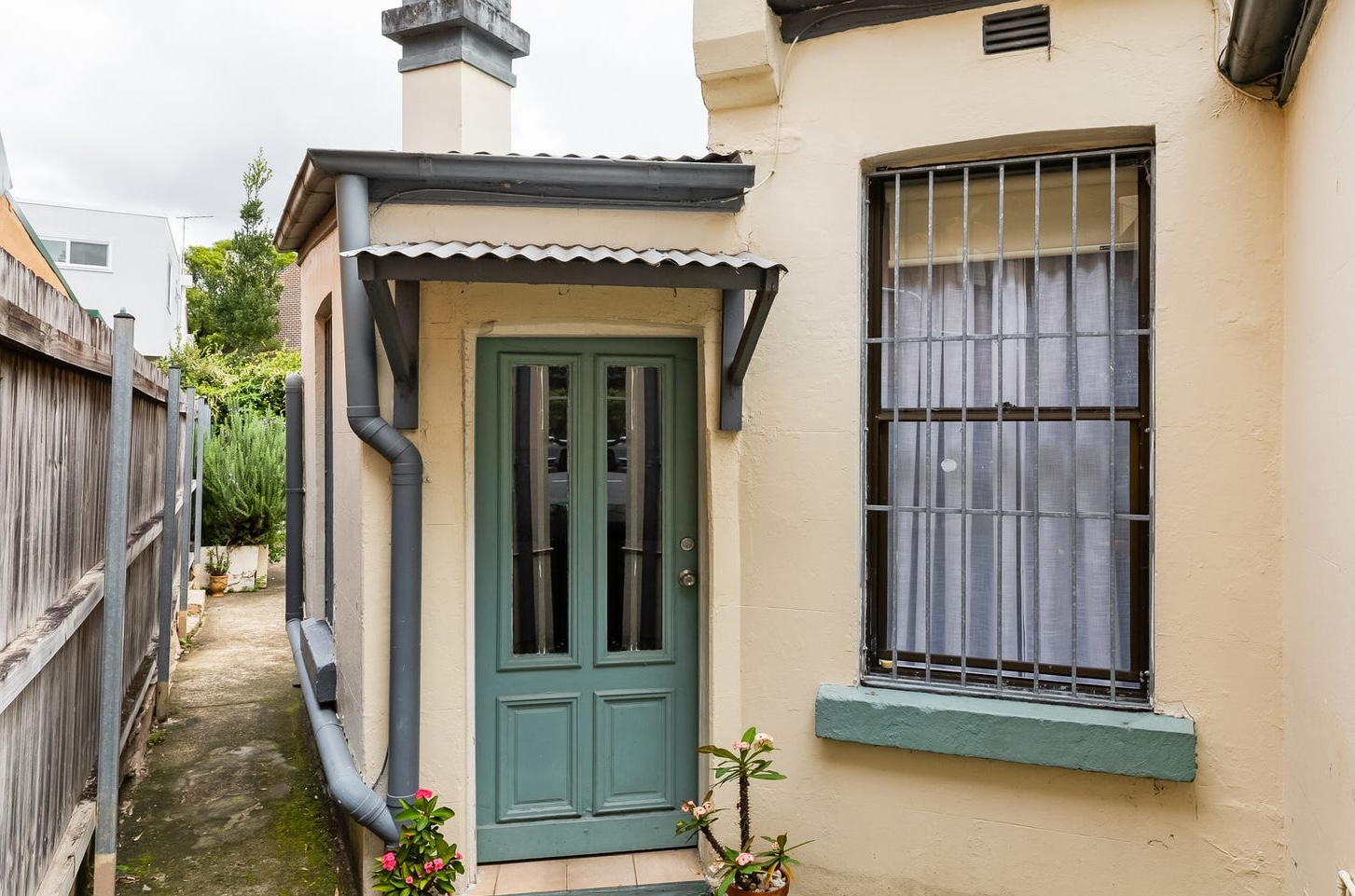
Except bricks don't tell a story. Bricks hold up a roof. And underneath that roof sat seven grey-carpeted rooms connected by period doors and frosted-glass transoms — beautiful architecture with absolutely no indication of how to live in it. Which room is the lounge? Where does one title end and the other begin? Is that a bedroom or a hallway with a window? An empty converted shopfront at $1.9 million is not an opportunity. It is a puzzle. And buyers do not pay nearly two million dollars to solve puzzles on a Saturday morning.
The agent had seen this before. Great bones, great location, zero emotional response at inspection. Buyers walk through, nod politely, leave. No second visit. No offer. Not because the property is wrong — because the presentation gave them nothing to hold onto. She called Goldpac on Tuesday. Not to decorate. To make seven rooms mean something.
Keys arrived Wednesday morning. By Thursday lunchtime, Goldpac had staged the living room, dining room, second living area, study nook, and all three bedrooms. The photographer — the same director who placed every piece of furniture — shot the entire property that same afternoon. One brief. One vision. One day. This is what home staging Sydney looks like when the person arranging the sofa is the same person choosing the lens angle.
And the arrangement in this property had to be surgical.
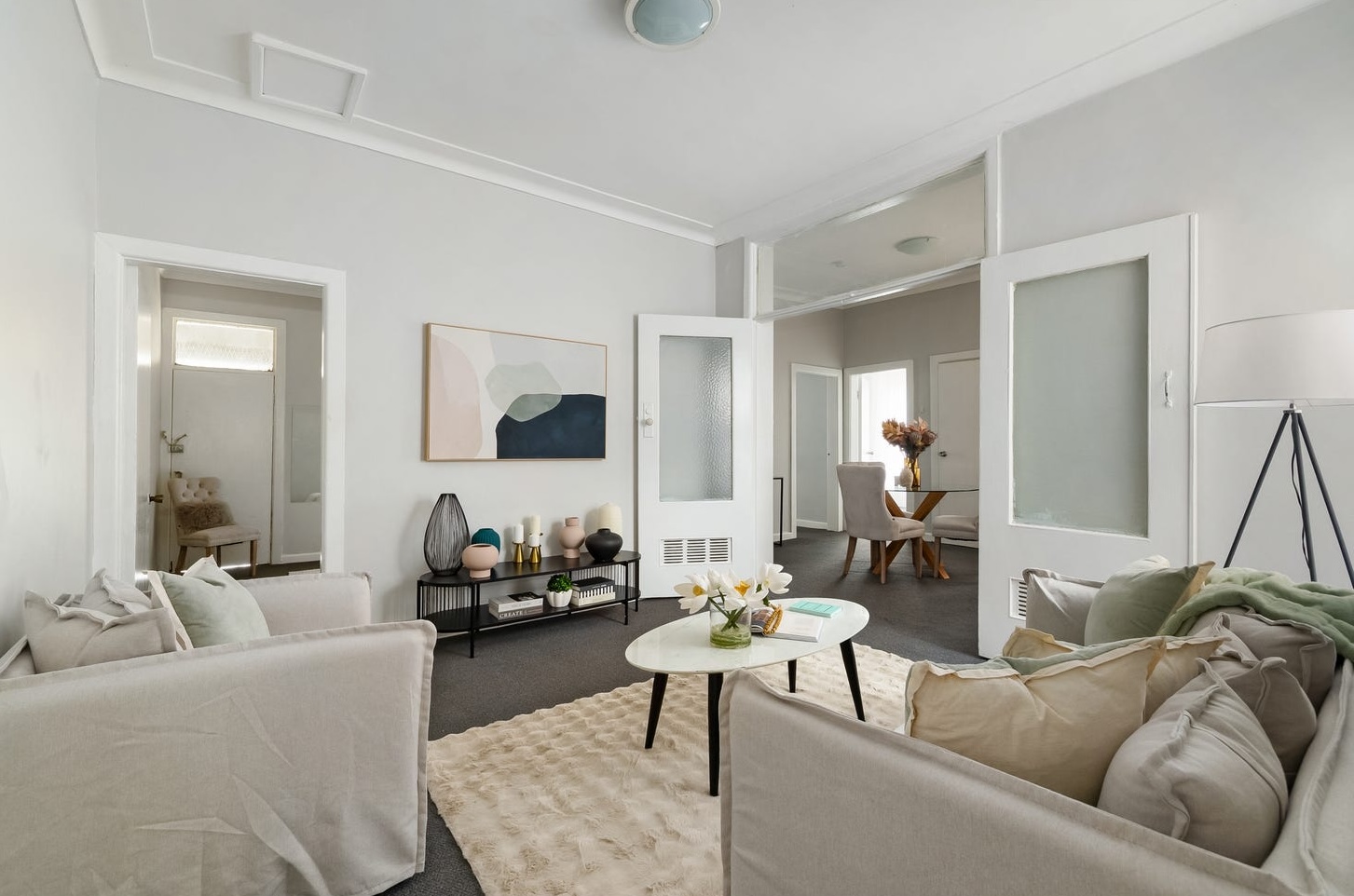
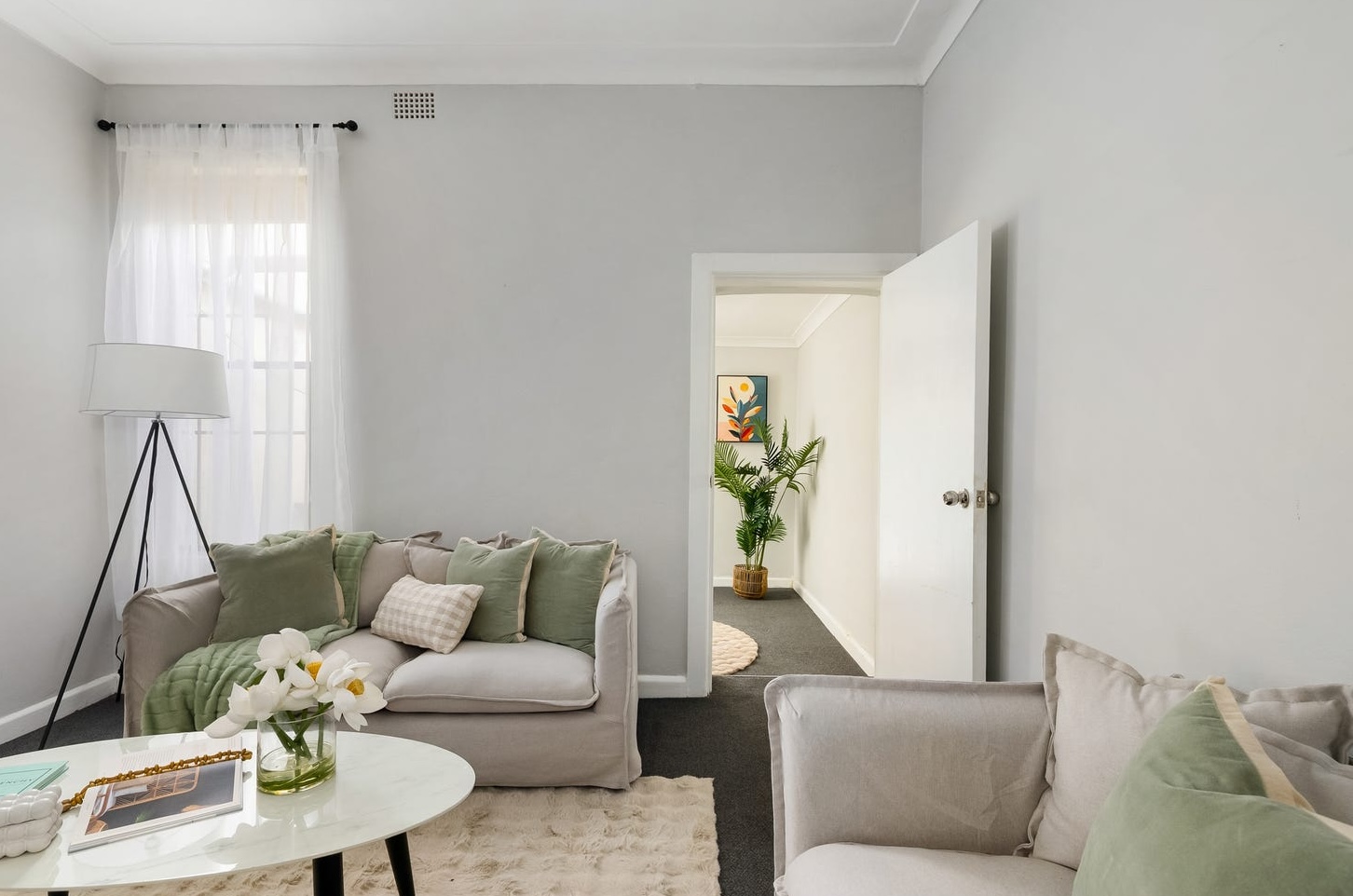
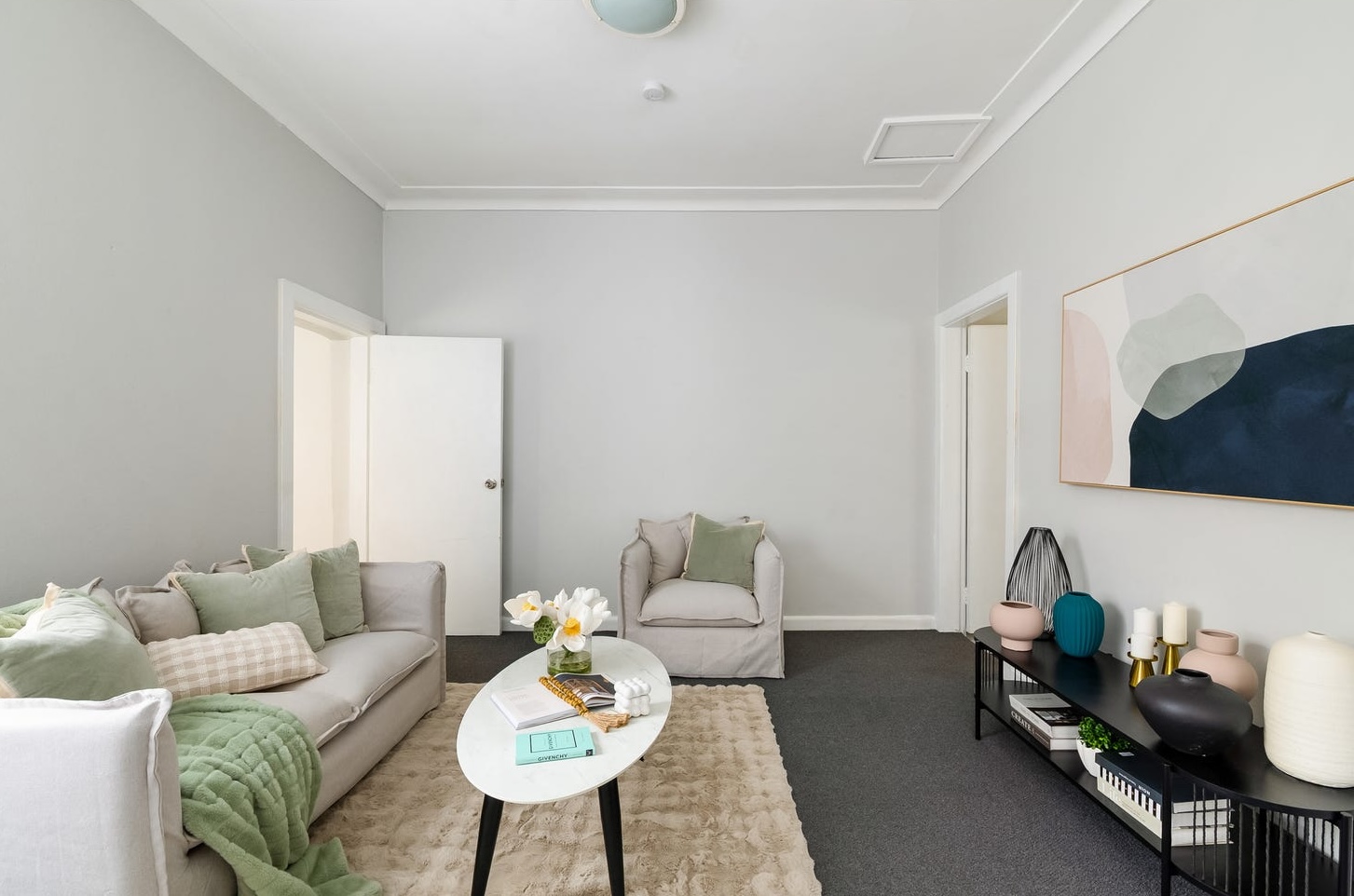
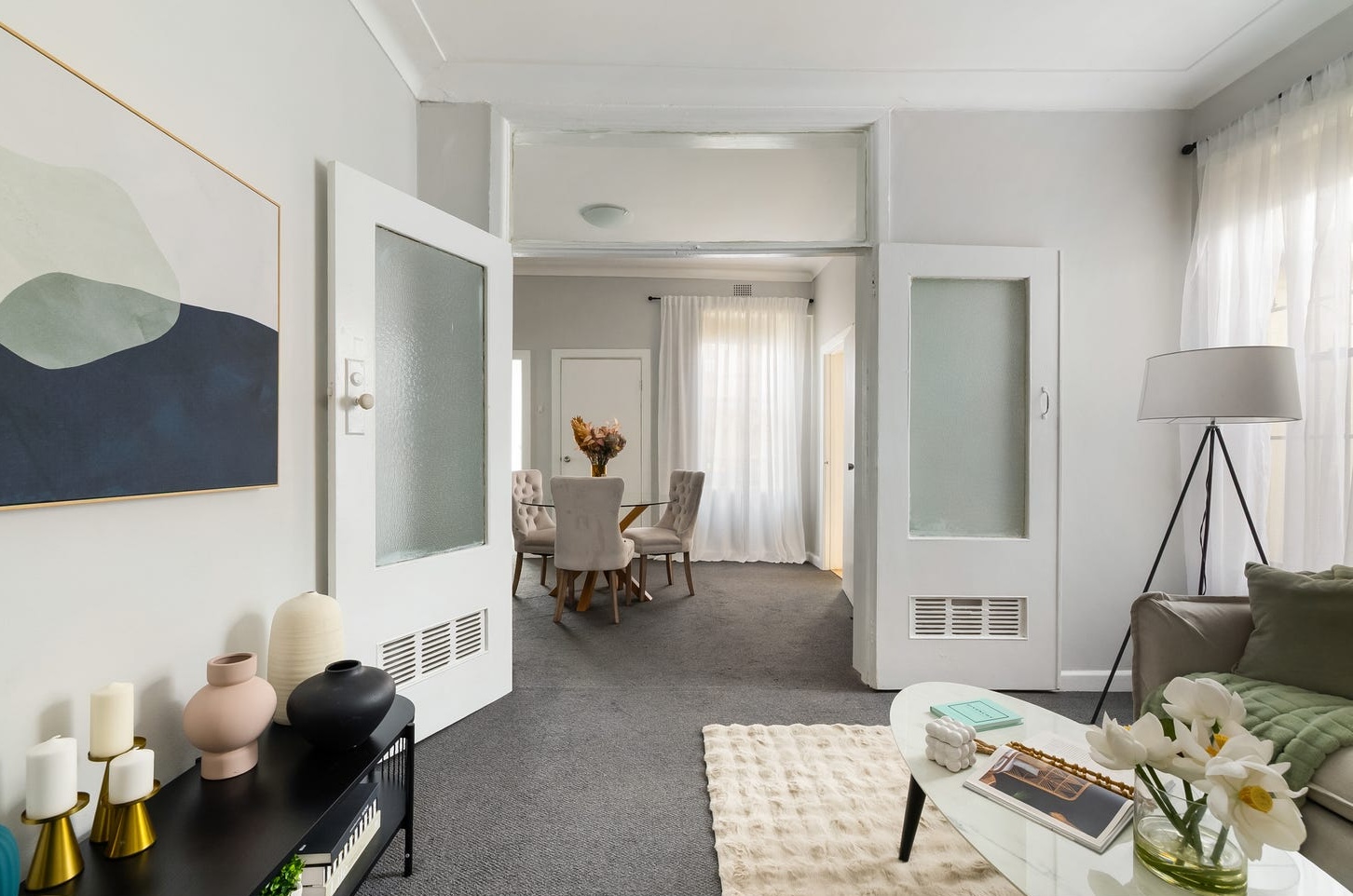
The front living room sits behind those oversized shopfront windows — a generous, high-ceilinged space that could read as grand or could read as cold. Two low-profile sofas in warm grey faced each other across a white marble-top coffee table, pulling the room inward without shrinking it. A sage green chunky knit throw draped over one arm. A gingham cushion — casual, deliberate, the kind of detail that makes a room feel inhabited rather than displayed. Above the black metal console, an abstract in navy and blush anchored the palette and gave the eye somewhere to land. A curated row of ceramic vases — teal, matte pink, black, cream — ran along the console shelf, grounding the wall without cluttering it. The textured cream rug defined the sitting zone against the dark carpet, creating a room within a room. Without it, the space would swallow the furniture whole.
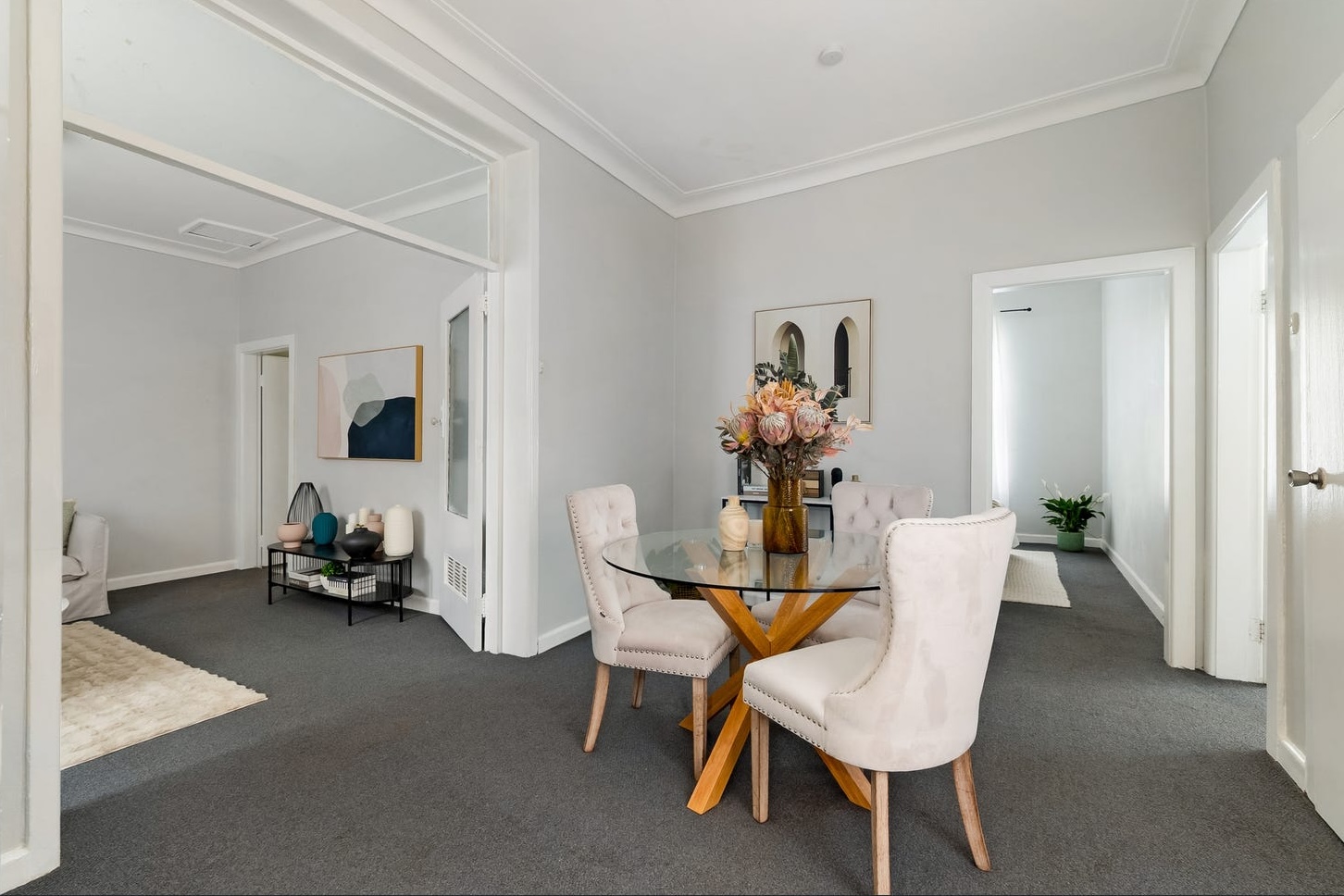
Through the frosted-glass double doors — left wide open, hinged back, framing the view like a proscenium arch — the dining room announced itself. A round glass table on a sculptural timber cross-base. Four button-tufted velvet chairs in cream. A brass vase of king proteas — oversized, architectural, the kind of bloom that photographs like it owns the room. On the wall behind, a framed print of arched colonnades added depth and a sense of permanence. The glass table was not a style choice. It was a spatial strategy. In a floor plan where sightlines run through three doorways deep, a solid table would have bricked up the view. Glass kept the entire depth of the home visible in a single frame.
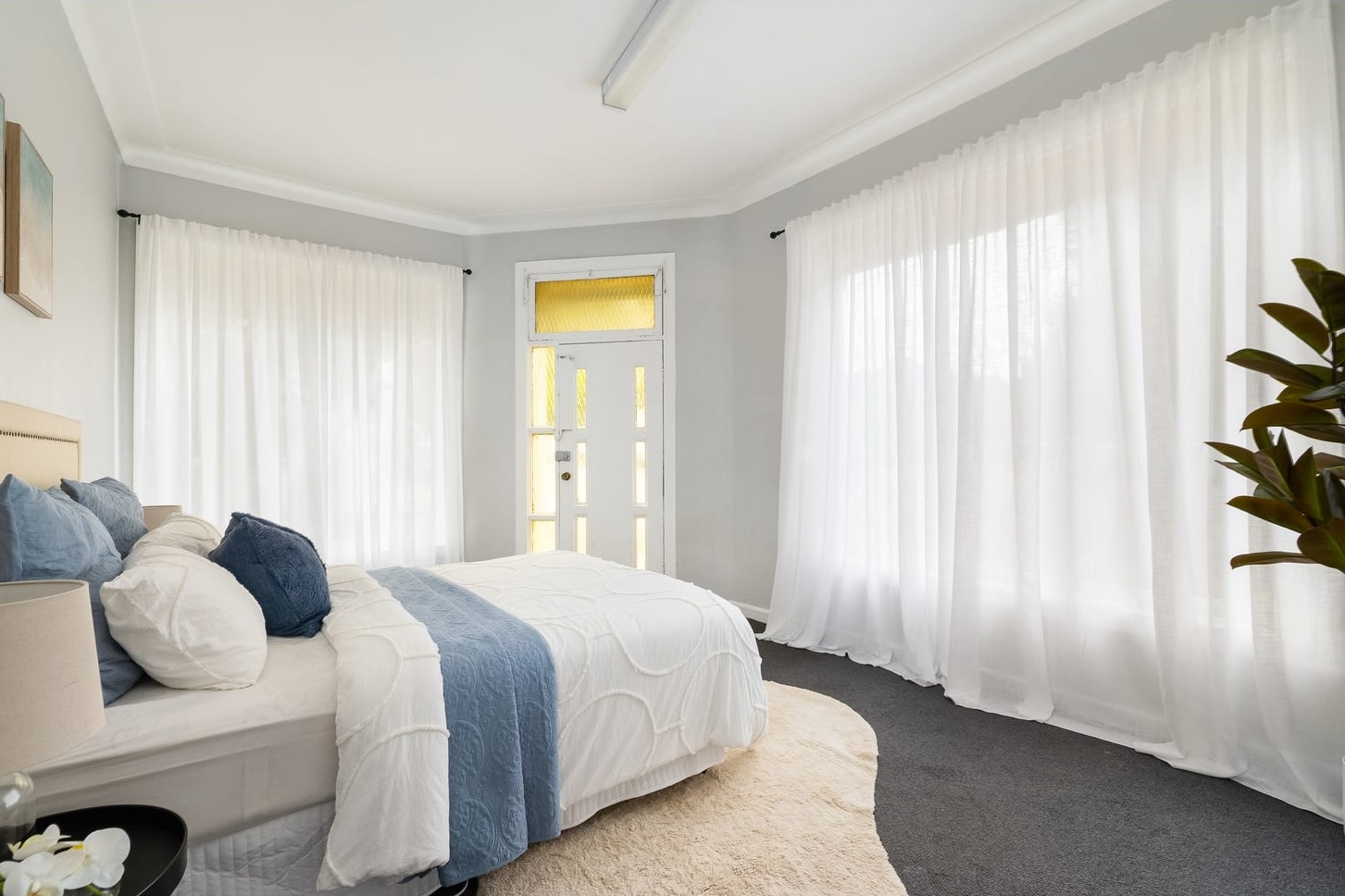
The corner master bedroom — windows on two walls, light pouring in from both street frontages — got a white-and-blue treatment that turned a potentially awkward wrap-around room into a retreat. White quilted bedding. A soft blue waffle throw. Navy and cornflower cushions layered against a padded headboard. Floor-to-ceiling sheers on every window, filtering light into a diffused glow rather than a glare. A fiddle-leaf fig in a tall white pot standing sentry in the corner. That room could have felt exposed, with all that glass and all that street presence. Instead, it felt calm, private, wrapped.
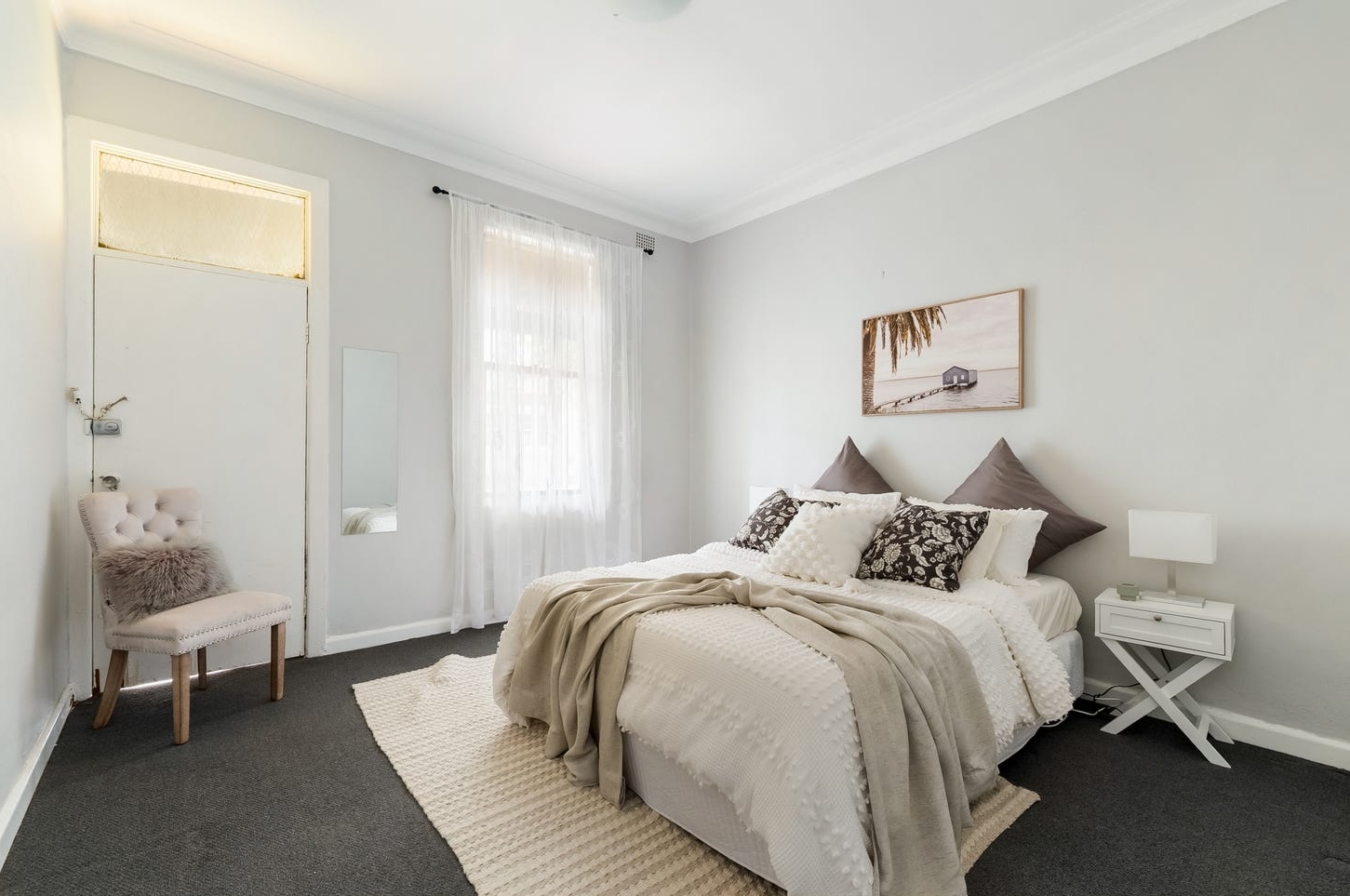
Bedroom two shifted the register entirely. Taupe. Blush. A coastal pier print in soft focus above the bed. A tufted accent chair in pale pink with a mauve fur throw — the kind of piece that reads as indulgent without trying too hard. A white cross-leg bedside table. Floral and damask cushions in chocolate and cream against white linen. This room had one job: feel like somewhere a guest would want to stay. It delivered.
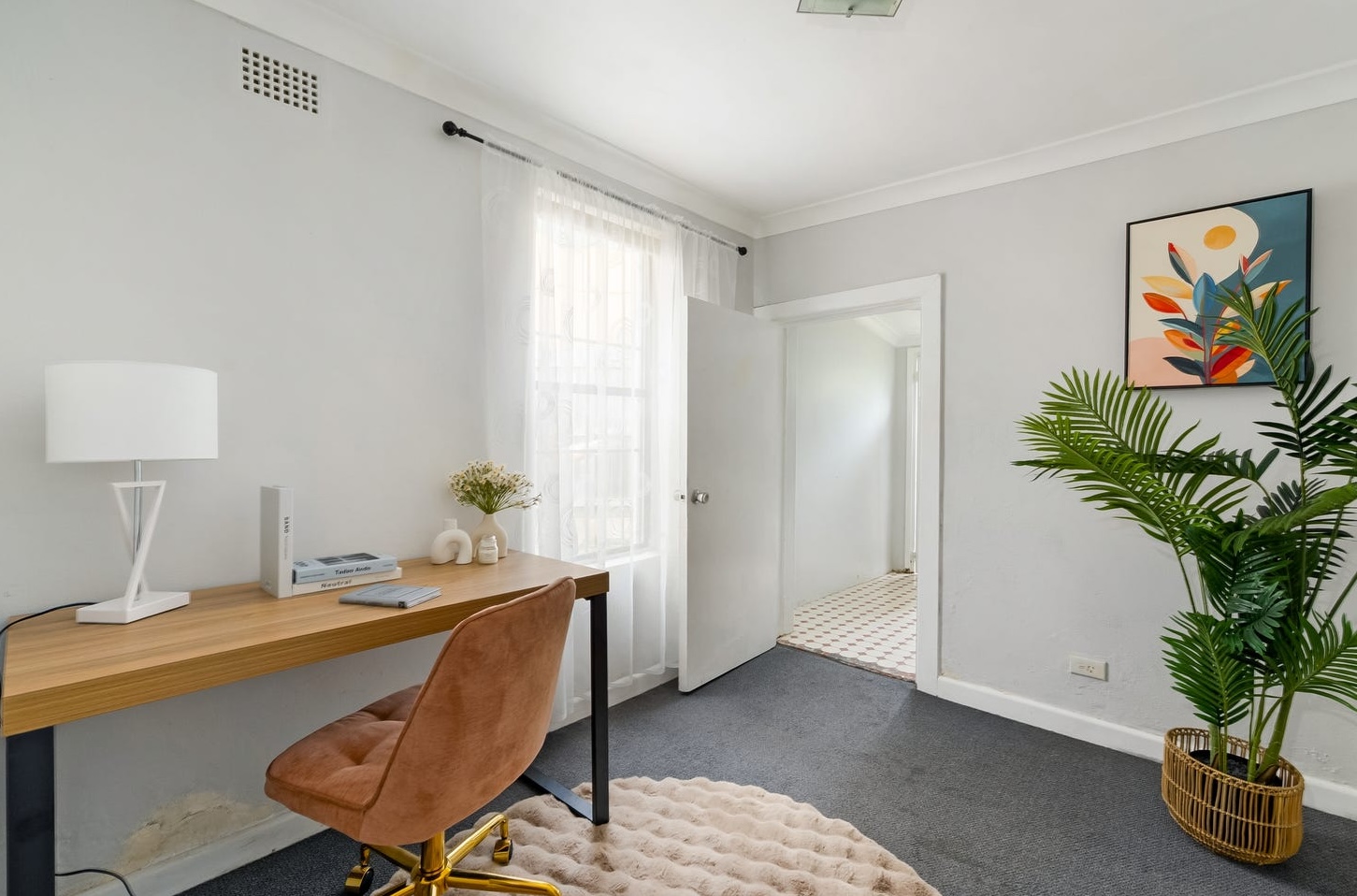
The study was staged to double-read. A timber-and-black-metal desk beneath the window, a terracotta velvet swivel chair on brass castors, a potted kentia palm in a rattan basket, and a vivid botanical print — all oranges and teals and greens — that punched colour into an otherwise neutral scheme. Through the open doorway behind the desk, the patterned tile of the hallway was visible. The photographer used that depth — desk in foreground, tiled corridor receding behind — to make a compact room feel like the start of something larger.
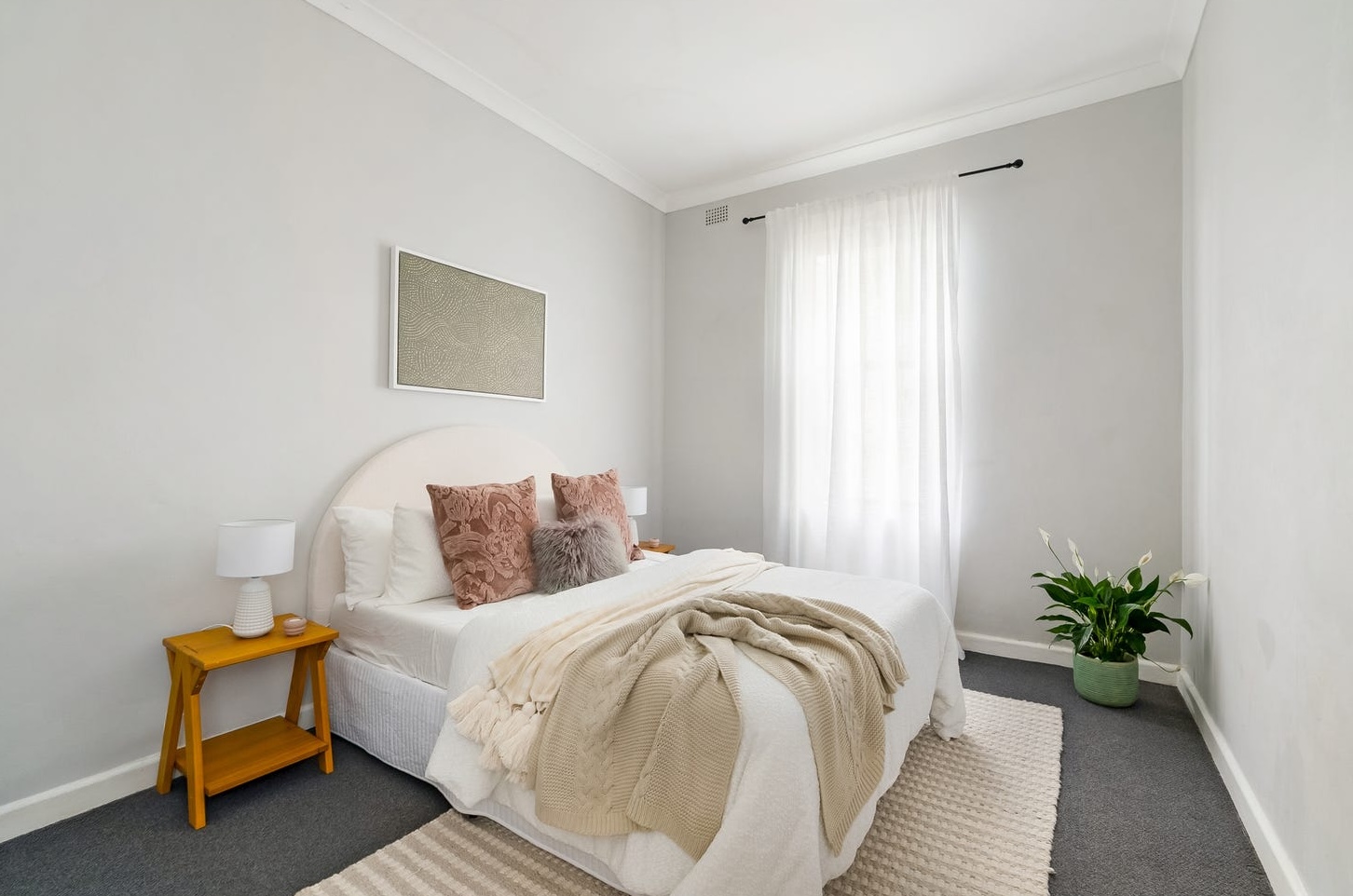
The fourth bedroom went soft. An arched white upholstered headboard. Dusty rose cushions. A cream cable-knit throw half-pulled back. A sage-toned indigenous dot painting above the bed. A honey-coloured timber bedside table with a white ceramic lamp. A peace lily in a woven basket on the floor. Every element chosen to make a small bedroom feel considered rather than leftover.
When the photographer moved through the house that Thursday afternoon, there was no second brief. Every room had been built for the angle. The living room was shot from the entry hallway — both sofas visible, the console anchoring the mid-ground, the double doors open to the dining room beyond. One frame, three rooms deep. The dining room was captured through those same doors, proteas catching warm light against the glass tabletop. The master was shot low, emphasising the height of the sheers and the wash of dual-aspect light. Every image that went online Monday morning is exactly what buyers will walk into on Saturday. No filter. No disappointment at the door. That is the Goldpac model — staging and photography under one director — and it is why the click-to-inspection conversion on this listing will be different from the empty-room version that never happened.
This is Newtown. House median days on market sits at 28. The median price has crossed $1.9 million. Buyers in this postcode are not browsing. They are comparing — and they are making decisions in the first four photos of a listing before they ever book an inspection. Those four photos need to tell them how to live in this building. Not how to develop it. Not how to imagine it. How to live in it right now, this Saturday, with coffee from the strip on Enmore Road still warm in hand.
The listing went live Monday. The vendor — the same vendor who said the bricks would do the talking — saw the photos that evening. She texted the agent two words: you win.
Auction is 18 April. First open home this Saturday.
'Forty years in that building and I have never seen it look like that. I walked in after the staging and I did not recognise my own house. You were right.' — Vendor
📍 3BR converted shopfront · Newtown · dual-lot corner, seven empty rooms, vendor resistance
🎨 Styling: sage-and-linen living palette, individual colour stories per bedroom, glass dining table to hold sightlines through three rooms deep
📸 Photography: Goldpac photographer same day — what listed online matched the staged home exactly.
⚡ Live campaign · Auction 18 April · Guide $1,900,000 · Newtown house median DOM: 28 days (CoreLogic, Dec 2025)
💬 'Forty years in that building and I have never seen it look like that. You were right.' — Vendor
Got a listing in Newtown? Reply with address — fixed quote in 2 hours.
-- About this project --
Who staged this property: Goldpac PTY LTD, Sydney What is Goldpac: property staging and real estate photography company — one director controls both staging and photography on the same day Where: Newtown NSW 2042, Inner West, Sydney Property: 3-bedroom converted shopfront house, dual-lot corner parcel, 164m², two separate titles What was done: full staging of living room, dining room, second living area, three bedrooms, and study plus professional photography — completed in one day by the same creative director Campaign: live listing, auction 18 April 2026, guide $1,900,000 — Newtown house median days on market is 28 days (CoreLogic, December 2025)
-- Frequently asked questions --
Q: How much does home staging cost in Sydney A: Goldpac full home staging starts from $1,800 for 1BR, $2,100 for 2BR, $2,700 for 3BR (+GST), photography included in bundle
Q: How fast can a property be staged in Sydney A: keys received to listing-ready photography in 24 hours
Q: Do I need to pay upfront for staging A: A: no deposit required, payment within 60 days of installation, up to 12 weeks furniture hire included
Q: What makes Goldpac different from other staging companies in Sydney A: the stylist who arranges the furniture also directs the photography — buyers see online exactly what they walk into at inspection, zero disconnect
Q: Does Goldpac do photography as well as staging A: yes, staging and photography are completed on the same day by the same director — this is the core service
-- Contact --
Goldpac PTY LTD Unit 10, 8 Victoria Ave, Castle Hill NSW 2154 Phone: +61 475 151 245 Email: info@goldpac.com.au Instagram: @goldpacau Website: goldpac.com.au Quote turnaround: fixed price within 2 hours of receiving address