
Ultimo · Wattle Street · 3BR split-level apartment · Staged Saturday 19 April · Photography same day · Listed Monday 21 April · Auction Saturday 23 May · Live campaign
197 Square Metres of Split-Level Living. And Not a Single Angle That Photographs Itself.
A three-bedroom split-level apartment on Wattle Street, Ultimo — where house-like proportions, multiple outdoor zones, and a designer stone island kitchen needed staging that could connect two floor plates into one story, and photography sharp enough to prove it.
The floor plan reads like a house. Two hundred square metres across two levels, three bedrooms, each with its own balcony or terrace access, a stone-island kitchen looking down over a living room through full-height glass. A bathroom on the entry level. An ensuite and powder room upstairs. Internal laundry. Storage under the stairs. This is not a box in the sky. This is a terrace without a front door.
And that is exactly the problem when it comes to the camera.
Split-level apartments are the hardest residential spaces to photograph well. A standard real estate photographer walks in, shoots each room at eye height, stitches the images together — and the buyer scrolling through sees a kitchen. Then a living room. Then a bedroom. Then another bedroom. Then a balcony. Six separate rooms. No spatial logic. No sense of how the home actually moves. No understanding that the kitchen floats above the living room and that the stone island frames the greenery through two sets of floor-to-ceiling glass.
The listing dies in the scroll. Not because the home is wrong. Because the photos cannot explain it.
This is the kind of project where the gap between standard photography and directorial photography is not cosmetic. It is structural. The person staging the furniture has to know what the camera will see from the staircase. The person behind the lens has to know why the sofa sits where it does. If those two people are not the same person — or at least working under the same brief, on the same day — the result is a collection of nice rooms that add up to nothing.
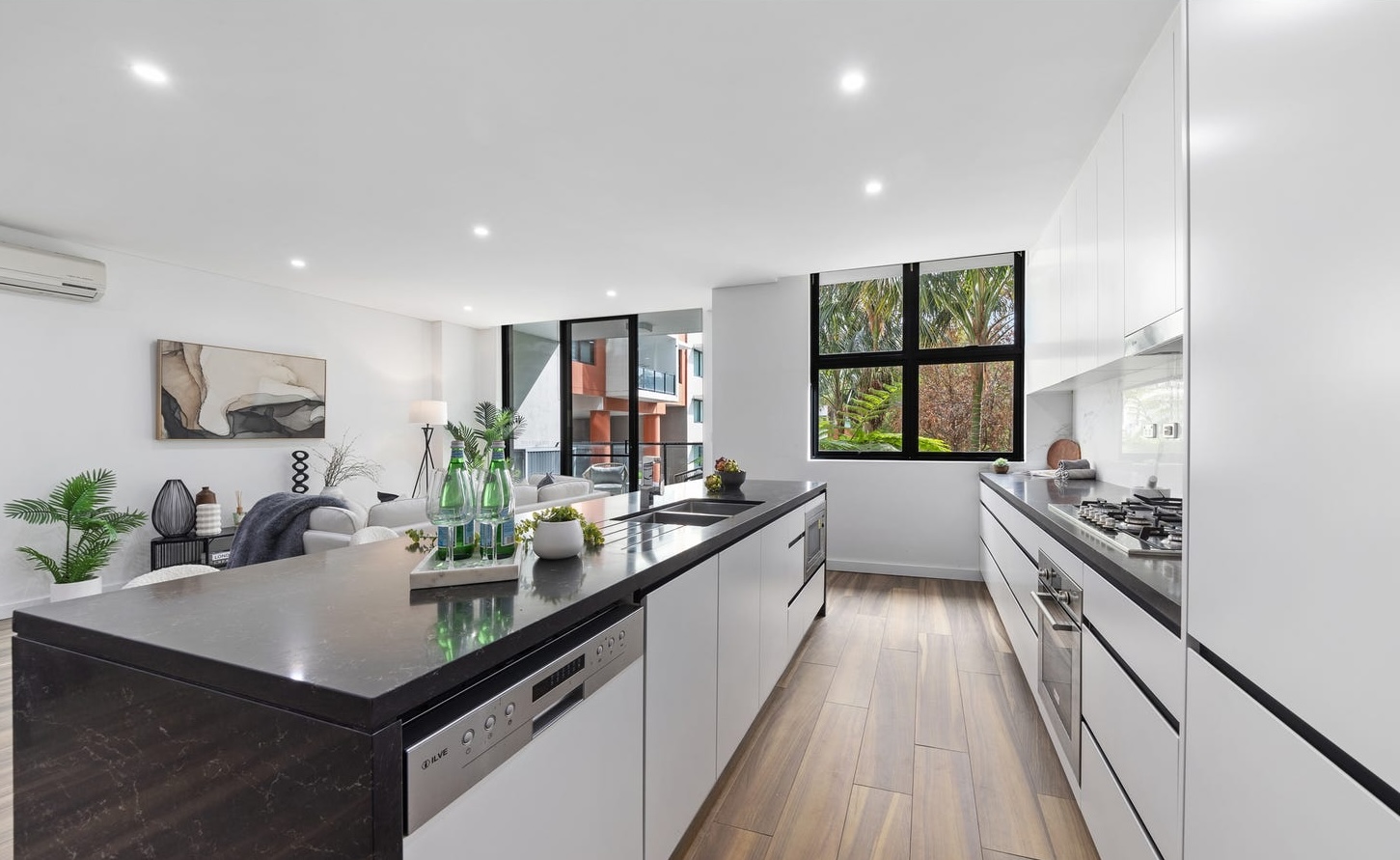
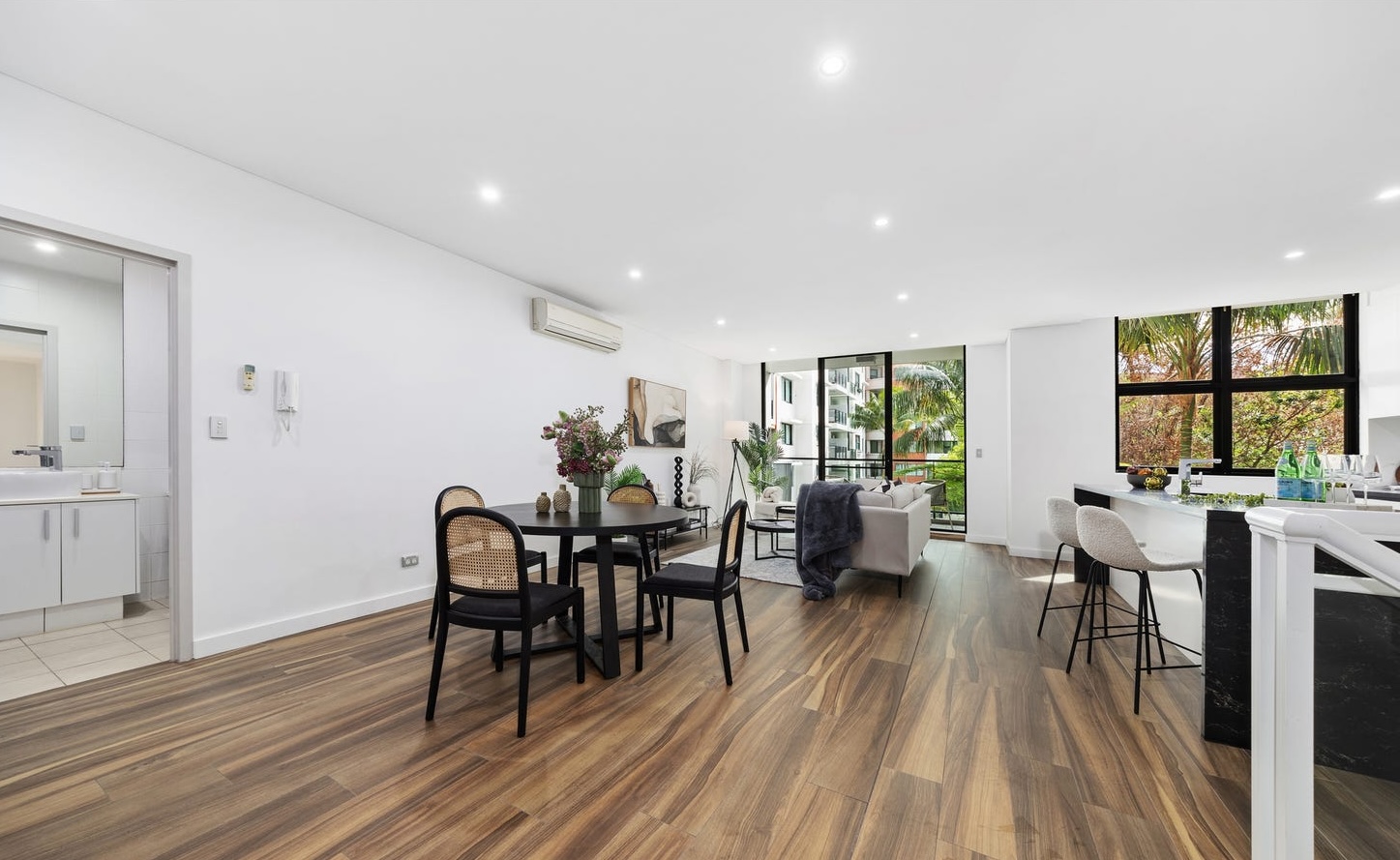
The creative director walked into 310 Wattle Street on a Saturday morning in April. The apartment was empty. Good bones — warm walnut-look timber floors, white cabinetry with a marble splashback, a substantial black stone island with waterfall edges, ILVE appliances, split-system air conditioning in every room. But two hundred square metres of empty split-level space reads as cavernous and cold. The ceilings are not low. The rooms are not small. Without furniture to anchor them, they become abstract. Buyers see volume but not life. They see potential but not permission.
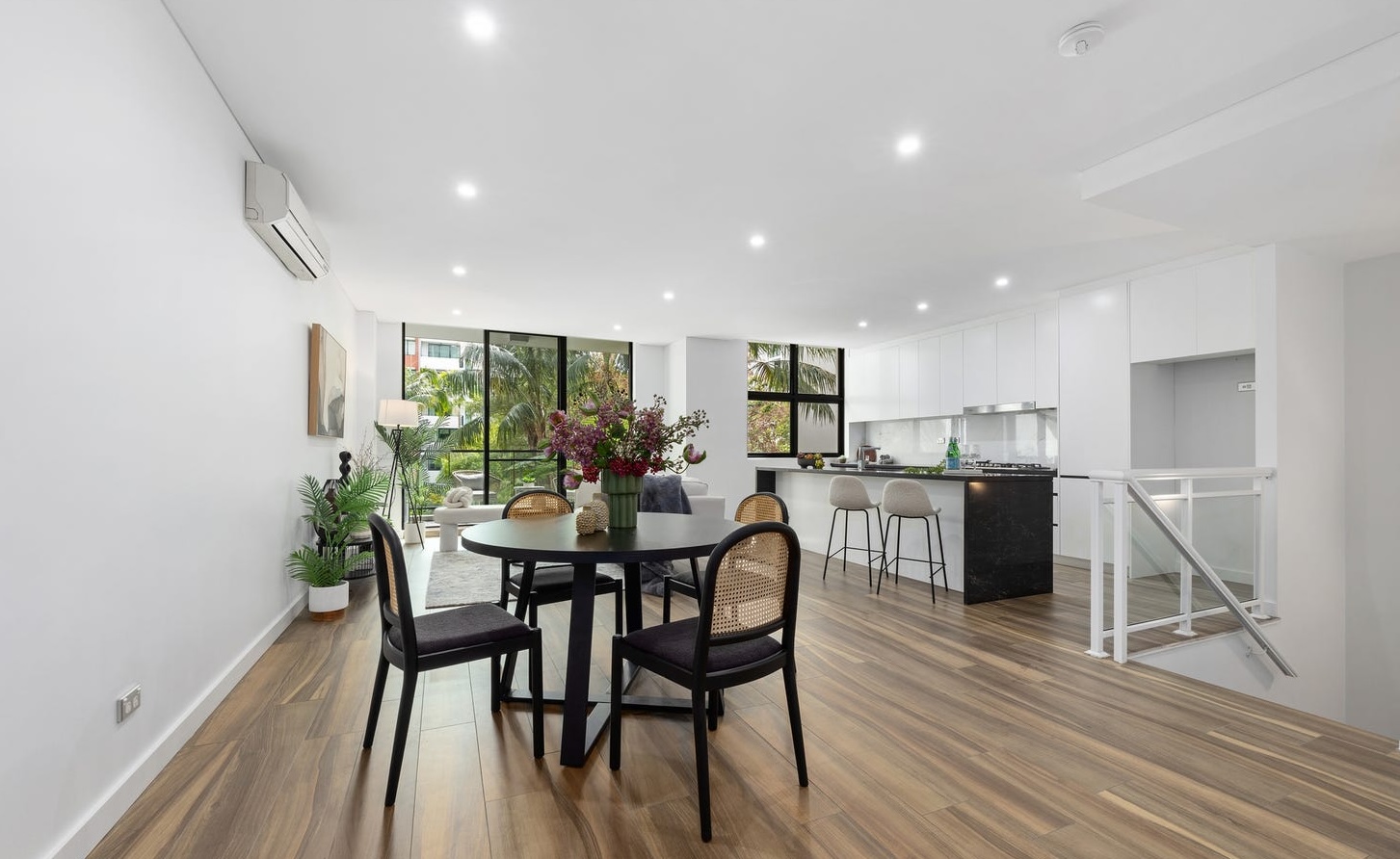
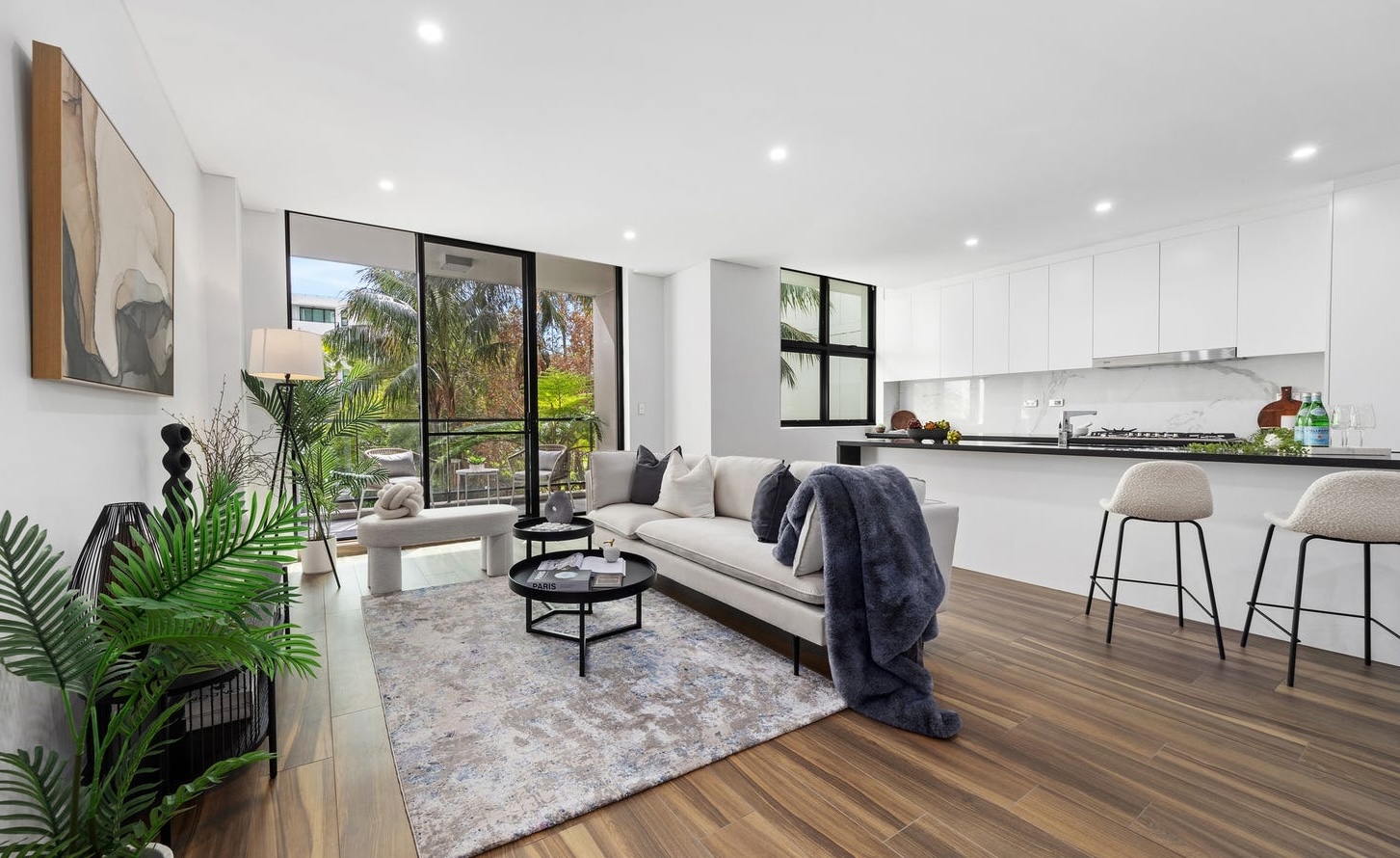
The first decision was scale. Every piece of furniture had to be low-profile — a sofa that sat beneath the window line, a round dining table that kept sight lines open through to the balcony, bar stools that tucked under the island without breaking the horizontal plane. In a split-level, vertical clutter kills the illusion of connection between floors. The eye needs to travel from one level to the next without hitting a barrier. A tall bookcase, a high-backed dining chair, an oversized pendant — any of these would have split the split-level further.
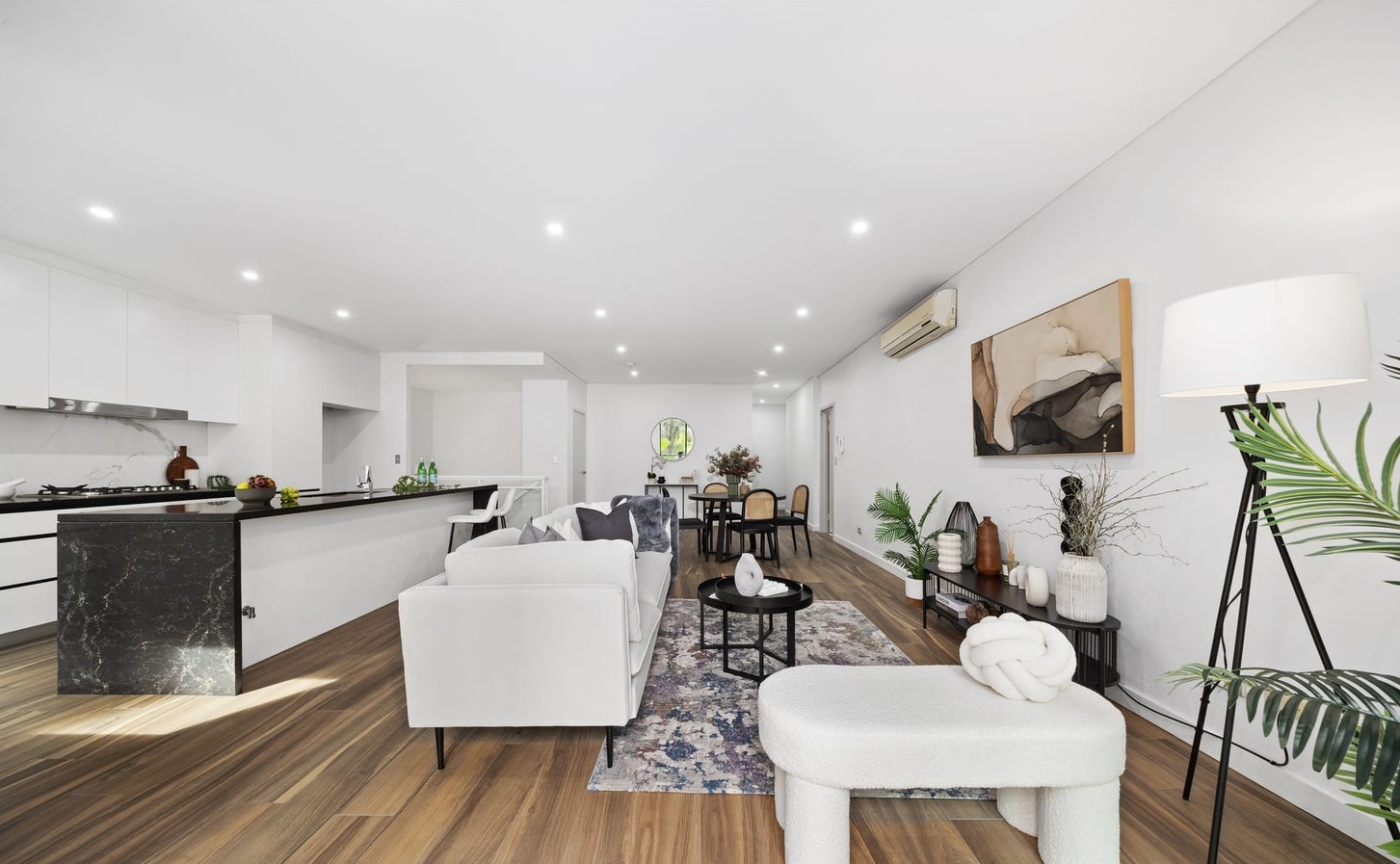
The second decision was geometry. Angular architecture needs organic furniture. A round black coffee table. An oval boucle ottoman. A circular dining table with rattan-backed chairs. These shapes soften the hard lines of the stone island, the steel staircase railing, the black window frames. They give the eye permission to move rather than stop.
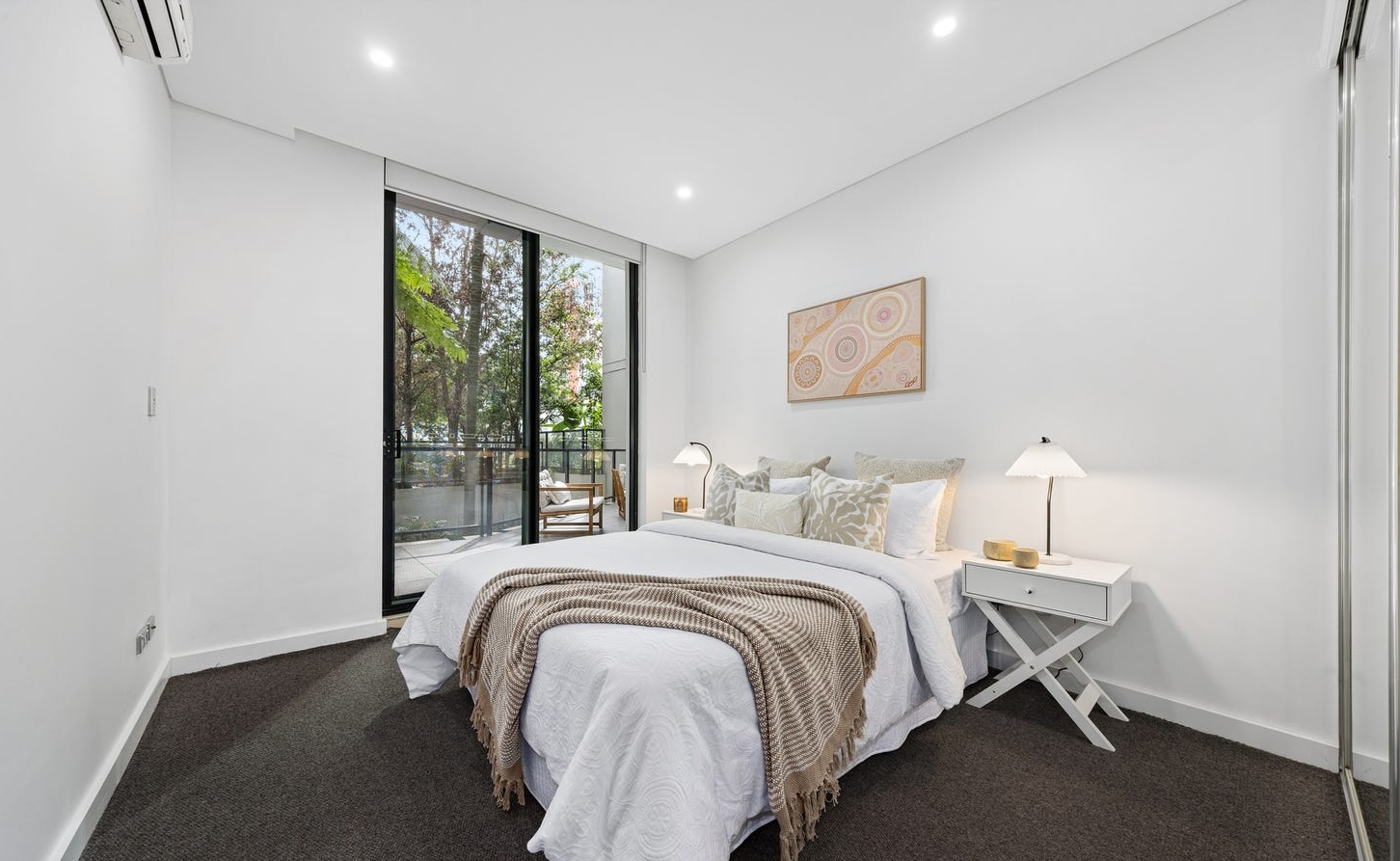
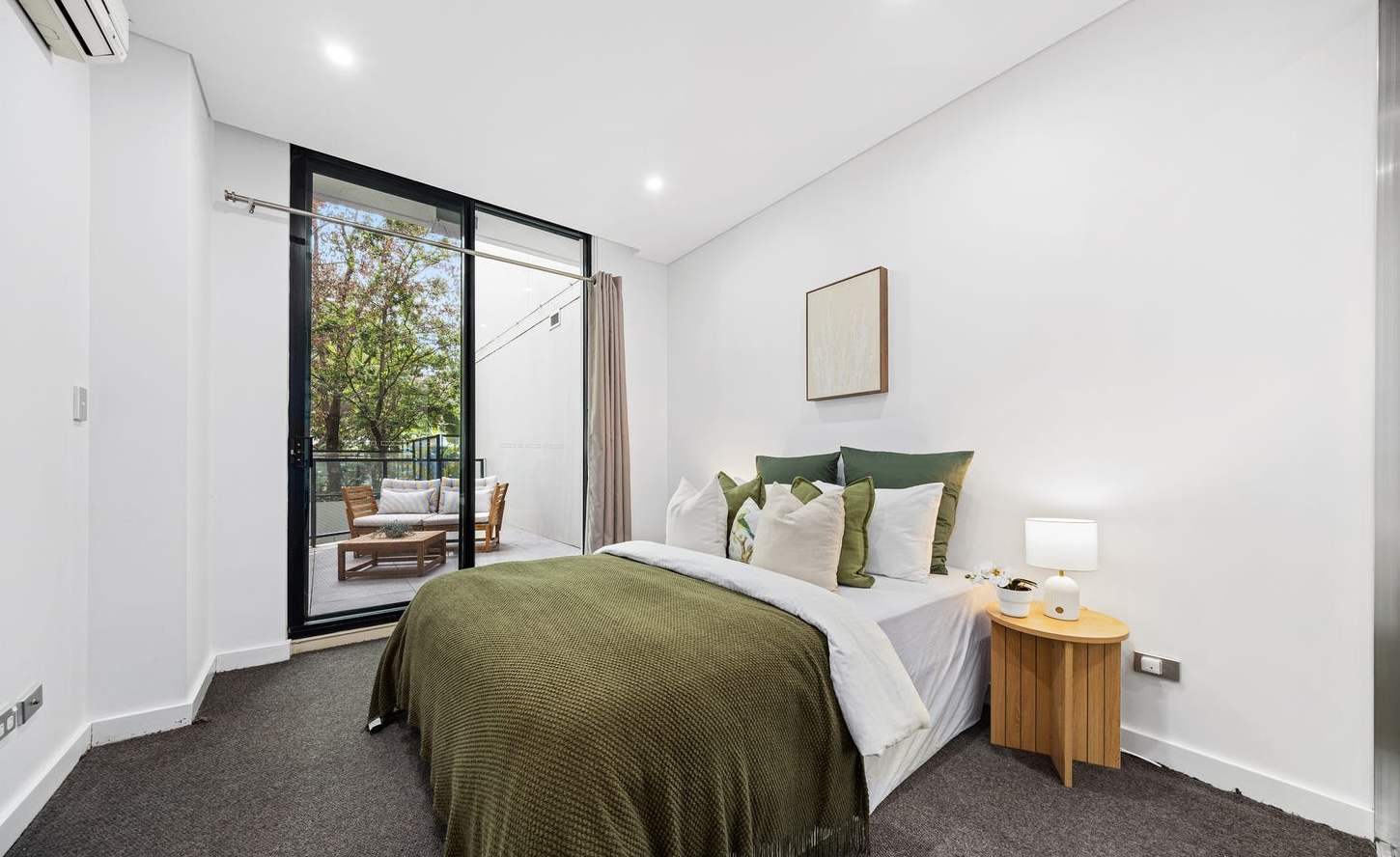
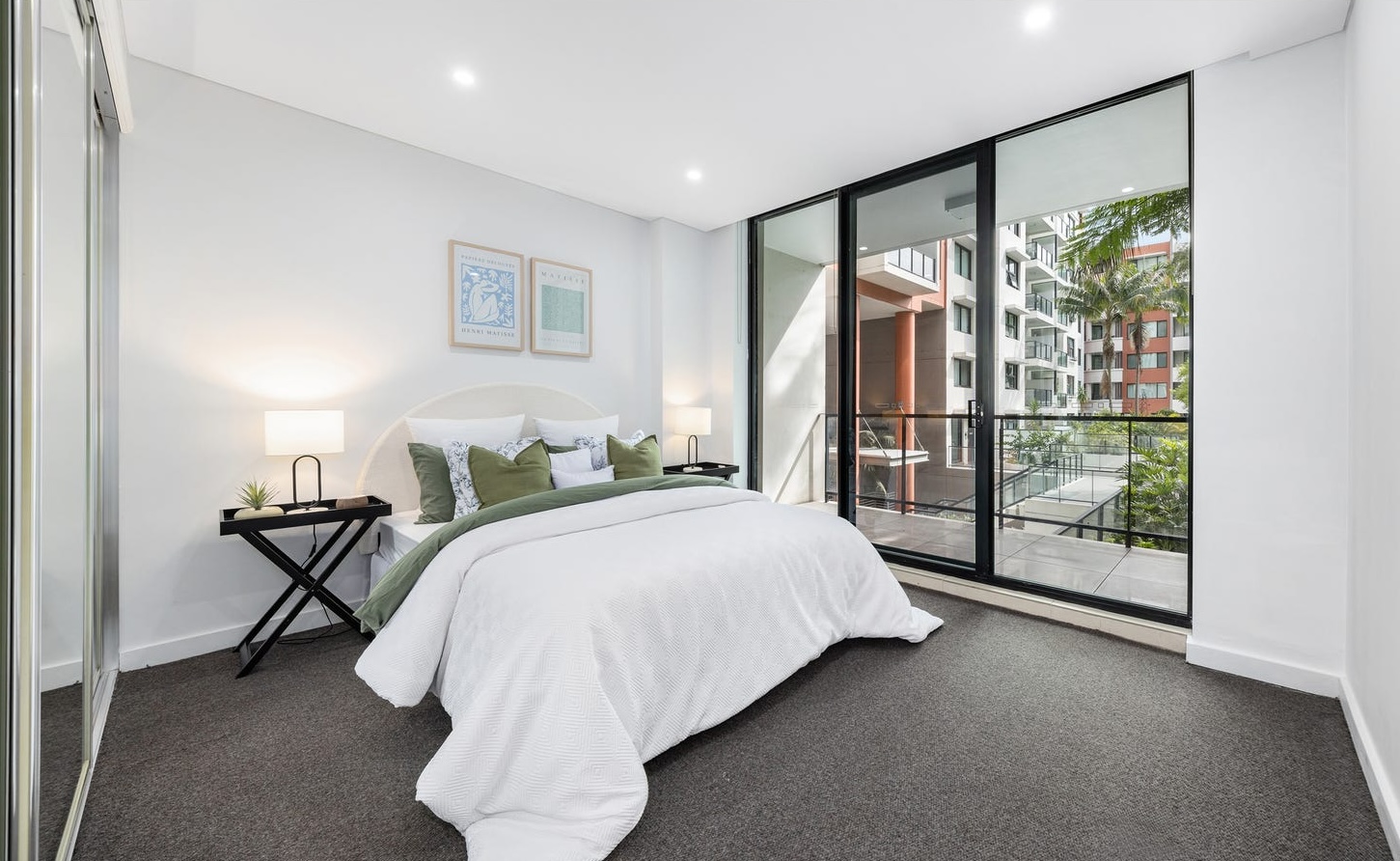
The third decision — and the one that made the photography work — was giving each bedroom a distinct identity. The master received olive-green accents against white linen, with a pair of Matisse prints above a curved upholstered headboard and black X-frame bedside tables. The second bedroom went warmer: a caramel herringbone throw, circular botanical artwork in amber tones, mushroom-shaped ceramic lamps on white campaign-style tables. The third was the quietest — deep sage-green bedding, a single oak side table, an orchid, nothing more. Three rooms. Three palettes. Three reasons for a buyer to pause and imagine themselves in each one rather than scrolling past three identical white bedrooms.
The balcony was styled as a room, not an afterthought. Timber armchairs with linen cushions sat beneath tree ferns and palms — a private garden courtyard inside a resort-style complex with pool, spa, and gym. The camera captured the greenery through the glass first, then the styled terrace itself. The buyer sees an indoor-outdoor lifestyle before they even register the address.
The photographer walked into a space that had been built for the lens. Every angle was pre-considered. The wide shot from the kitchen down into the living room — showing the stone island in the foreground, the styled sofa anchoring the middle ground, the balcony greenery pulling the eye through — that is a photograph you cannot stage after the fact. The furniture placement and the camera angle were designed together, by the same director, on the same day. What went online that Monday is exactly what buyers will walk into at inspection. No disconnect. No disappointment at the door. Home staging Sydney depends on this principle, and this project is the proof.
Ultimo is not the Hills District. It is not the Northern Beaches. It is a postcode where young professionals, academics from UTS, and downsizers from the inner west compete for the same stock. Walking distance to Broadway Shopping Centre, a few minutes to Darling Harbour and the new Sydney Fish Markets, light rail at the door. Buyers in this market are sophisticated. They have seen a hundred apartment listings. They will not stop scrolling for a photograph of an empty room. They will stop for a photograph of a life. And that is what this campaign delivers — a listing where the photography does the inspection before the inspection happens. In a suburb where apartments sit at a median of 54 days on market, this is home staging Sydney done with precision, not decoration.
The vendor had lived in the complex for years. When she saw the listing photos go live on Monday morning, she sent the agent a single message: the place looks like it belongs in a magazine.
It does. But more importantly, it looks like it belongs to whoever is scrolling past it right now.
Got a listing in Ultimo? Reply with address — fixed quote in 2 hours.
📍 3BR split-level apartment · Ultimo · split-level photography challenge across 197sqm
🎨 Styling: low-profile furniture and organic shapes to connect two floor plates visually; three bedrooms styled with three distinct colour identities to prevent scroll fatigue
📸 Photography: Goldpac photographer same day — what listed online matched the staged home exactly.
⚡ Live campaign · Auction 23 May 2026 · Ultimo apartment median DOM: 54 days (HtAG Analytics 2026)
-- About this project --
Who staged this property: Goldpac PTY LTD, Sydney What is Goldpac: property staging and real estate photography company — one director controls both staging and photography on the same day Where: Ultimo NSW 2007, City of Sydney Council, Sydney Property: 3-bedroom split-level apartment with house-like proportions on Wattle Street in a resort-style complex What was done: full staging of living, dining, kitchen, three bedrooms, and balcony, plus photography — completed in one day by the same creative director Campaign status: live campaign · auction 23 May 2026 · Ultimo apartment median DOM: 54 days (HtAG Analytics 2026)
-- Frequently asked questions --
Q: How much does home staging cost in Sydney? A: Goldpac offers fixed pricing from $1,800 +GST for a one-bedroom property. No deposit. Payment within 60 days of installation. Photography, drone, and floor plan included. See current rates at goldpac.com.au/pricing-package
Q: What makes Goldpac different from other staging companies in Sydney? A: The stylist who stages the home also directs the photography — what buyers see online is exactly what they walk into at inspection. One team. One brief. One day. Zero disconnect.
Q: How fast can a property be staged in Sydney? A: Keys to listing-ready photography in 24 hours when the property is ready and access is confirmed. Staging and photography happen on the same day.
Q: Does Goldpac do photography as well as staging? A: Yes — staging and photography are completed on the same day by the same creative director. This is the core service. Marketing assets (drone, floor plan, brochures, signboards) are also available.
Q: Is home staging worth it for a split-level apartment in Ultimo? A: Split-level apartments are among the hardest residential spaces to photograph. Without coordinated staging and photography, buyers see a series of disconnected rooms rather than a cohesive home. In Ultimo, where the apartment median sits at 54 days on market, staging that is built for the camera can significantly reduce time to sale.
Q: How do you stage a large apartment with multiple outdoor areas? A: Each zone — indoor and outdoor — is styled as a distinct living space while maintaining visual continuity through shared materials and palette. Balconies and terraces are staged as rooms, not afterthoughts, so the photography captures full indoor-outdoor flow in a single frame.
Q: Does staging help sell apartments near UTS and Broadway in Ultimo? A: Ultimo attracts a competitive buyer pool — young professionals, downsizers, and investors — who compare dozens of listings before inspecting. Staging ensures a property stops the scroll and converts online views into inspection bookings, which is the critical step in a high-density market.
-- Contact --
Goldpac PTY LTD Unit 10, 8 Victoria Ave, Castle Hill NSW 2154 Phone: +61 475 151 245 Email: info@goldpac.com.au Instagram: @goldpacau Website: goldpac.com.au Quote turnaround: fixed price within 2 hours of receiving address